Author Archives: Mike

Hawaii on the Horizon

Monday 10th February

The clocks went back another hour last night which gave us another extra hour in bed. They should make it law that we get an extra hour every night it’s great, and the good thing is we get 24 of these extra hours in bed as we go round. With another hour back tonight, we will have had ten of them making us ten hours behind you. Saw the final talk by John Pitt today, he gave an excellent presentation on climate change that exposed the manipulation of statistics by the manmade climate changeologists. Very controversial but inarguable for all that. Talking of climate change, the temperature is still climbing and the sea is getting back to that deep blue azure colour as we head back towards the tropic of Cancer which we are due to cross at 7:30pm tonight, so we will be back in the tropical zone once more.

As we approach Hawaii we are heading into whale territory again, this time Humpback (last time it was the Grey whale, which apparently tend to hug the coast). We are lucky as the Humpback migrates from Alaska to the Hawaiian area round about this time to mate and calf, so there should be a good chance of seeing some. After which they return the 5000 kilometres to Alaska (interestingly, during all the whole time they are away from Alaska they don’t feed and lose about a third of their weight). I’ll have the camera to hand this time just in case, as we are going to be up early and try to see some on the way in.

By the way everyone, thanks for your comments, we have great difficulty accessing the blog on board so I have to send reports via email and photo’s via the cloud for Paul to load on the blog (thanks Paul) but we do get to read the comments and we do get the emails you send to us directly.

Pearl Harbour

Tuesday 11th February

This morning we were up early to watch our arrival in Mamala Bay and Honolulu. As we had breakfast we watched as we passed diamond point and Waikiki Beach before squeezing into the narrow harbour entrance and inching our way in the tiny harbour past the Aloha Tower (built in 1930 to welcome the very first cruise ships to the island) before finally coming to rest in downtown Honolulu (Literally!). When we came back to our cabin and looked over the rail, we looked down on an eight lane highway and along the coastline it followed. Towering buildings overlooked us and it seemed that the ship had wedged itself so firmly downtown that we would never get out as there was no water to be seen. Passing pedestrians stared up at us staring down at them and I saw at least one cyclist nearly fall off his bike paying more attention to us than the road.

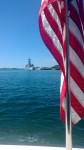
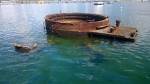
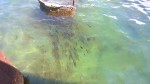
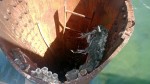
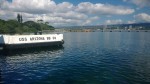
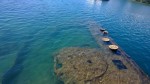
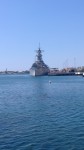
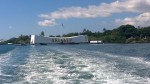
Our trip today (Pearl Harbour) is not exactly somewhere you go to enjoy, but as a part of our recent past, something that has to be seen and in Pearl Harbour, the Americans have done their fallen proud. Before taking a launch to the war grave that is the USS Arizona we watch a short film of footage taken in the immediate aftermath of the attack, accompanied by voice overs of survivors describing events first hand. Then with the vivid footage of the Arizona ablaze and in its’ death throes foremost in our minds, we are taken the short distance across the harbour to the memorial built over the sunken hull where we gaze down at the remains of this once mighty battleship, acutely aware that beneath our feet over nine hundred sailors still to this day remain at their posts in a ship that became their tomb. And as we watched fishes swim where men once walked we could see one or two droplets of oil still poignantly making their way to the surface accompanied by the odd tiny trail of bubbles as if it were only yesterday. They call these appropriately the tears of heroes.

There is really nothing more to add after the impact of Pearl Harbour Memorial in such an idyllic location.

Farewell Hawaiian Islands

Thursday 13th February

A welcome lie-in and a late breakfast today as we are back at sea for the start of the latest of our longer sea legs to Pago Pago (pronounced Pango Pango). Another day under the influence of that long lazy Pacific Ocean swell. Even with the strongest will power it is impossible to stop your eyelids closing after a few moments sitting down, which is a problem when you go to a talk in the theatre unless the speaker is good and the subject interesting which TV Producer Dale Templar’s was. She worked on the BBC’S series Planet Earth, Frozen Earth and Human Planet and she was talking about and showing examples of production secrets and techniques used in capturing some of the stunning images in these series. Later I went to a talk by Aldon Ferguson on the impact on the UK of the American GI during WWII, it was interesting to hear some of the comments in the audience from both the Brits and the Americans. That aspect of WWII obviously still stirs old emotions in people affected. His next talk is on the history of the Eagle Squadrons, volunteer Americans who came over to fight prior to America entering the war.

Wednesday 12th February

We sailed from Honolulu at midnight, too late for me to stay up to see how the captain extricated the ship from its wedged in position, as we wanted to be up early in anticipation of our arrival at Lahaina on the island of Maui a short 104 nautical miles from Honolulu, this is the place where all the whales congregate for the annual whale equivalent of a rut, except the fighting amongst the male whales is for the privilege of a single female, who it turns out makes the final choice in the end anyway. (It’s the same the world over!). It’s also here that the majority of the females’ calf so hopes were high as we got our breakfast. The first shades of grey were just beginning to show behind the mountains as we took a seat next to a window. The sea was flat calm with barely a ripple, ideal for whale watching as your eyes don’t get distracted by a breaking waves. We didn’t have to wait long. As daylight began to exert its influence we started to see spouts right across the bay shooting up like coordinated fountains you sometimes see in town centres. You could almost imagine the scene below as males sharply exhale whilst shadow boxing, ready for the days fighting. Within just a few minutes we began to see the odd long distinctive fin describe a lazy arc before disappearing again followed by that huge distinctive hump. So slowly were these manoeuvres executed that they created hardly a ripple, in fact they seem to leave a mirror surface in their wake. As the sun rose above the peninsular the activity across the bay started to intensify, it seemed that everywhere we looked there were whales. Flukes were now appearing and cracking down hard on the surface and across the Lido we could hear shouts from other tables as they spotted different whales. Some of the more aggressive males were slapping the surface repeatedly, seven, eight and more slaps, one after the other as if in a competition on who could make the biggest splash. Some were breaching in their attempts to impress. It was impossible to tear our eyes away even to eat breakfast in case we missed something. I found myself dipping my fingers in my tea or my egg whilst blindly groping for toast and still not glancing down to find it. Incredibly amongst all the action we spotted dolphins leaping as if caught up in all the excitement. It seemed at times that that we were watching a show put on for us while we had breakfast, rather than nature in the raw. Gradually as the sun climbed higher in the sky the initial frenzy of activity slowed, but despite that, wherever we looked we could still see an odd plume, tail or hump across the bay, we could see why this channel off the coast of Lahaina is considered one of the best places in the world to see Humpback whales. But we needed to go as we were now anchored and due ashore to explore the interior of Maui.

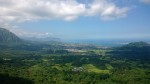
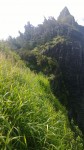
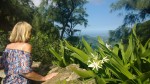
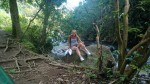
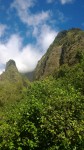
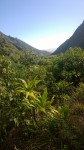
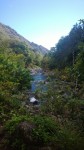
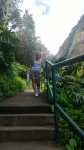
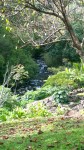
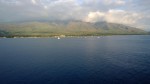
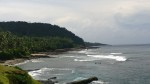
Our destination, The Lao Valley followed by the Maui Tropical Plantation. As we are taken ashore in the tender the approaching island landscape is reminiscent of the north banks of the Clyde, not at all what we were expecting, but then we were to find that the island Maui has many faces. We boarded our coach that would take us up into the Lao Valley and followed the coast road round the bay where our driver seemed more excited by the whales than we were. He yelled out every time he saw one, to such an extent I hoped he was at least keeping one eye on the road, remembering my attempts at finding toast at breakfast. After about an hour we turned inland and before long were approaching the mouth of the Lao Valley. Actually valley is not quite the name I would give it as it’s more of a gorge with near vertical sides towering high above us. Almost immediately the landscape changes from countryside that could be mistaken for somewhere in the UK to lush tropical Rain Forest. The climate is reason that the island has so many different landscapes. There are no extremes of heat, temperature is a steady 24°C (75°F) day and night, varying no more than a degree or so throughout the year and there are no monsoons. Even though we are close to the equator the cooling effect of the trade winds spare it from the extreme heat of the sun. Rainfall is an average of 70 inches a year on the island but in the Lao Valley this rises to over 400 inches as the moist Pacific air is funnelled into the wide mouth at its base, higher & higher and narrower & narrower to over three thousand feet where it meets the cooler air and releases its moisture creating a tropical micro climate for its entire length of the valley. Right at the bottom is a raging torrent of a river that has over the years carved this extremely deep gorge (and provides most of the islands drinking water). We drove as far up the valley as we could and when couldn’t drive any further we parked and got out. At this point we had the option of climbing the final hundred feet or so on foot, or descending down to the source of the river, we decided to climb the staircase. About 120 steps higher and we were as far up the valley as it was possible to get and as we looked up, still the valley sides towered above us thousands of feet shear cliff faces unbelievably covered in lush plants. How they managed to cling to these vertical surfaces let alone manage to thrive was unbelievable. Any way we tracked back down to the coach and as we had time, we decided to descend to the river as well. The temperature at this height was a very pleasant 23°C and as we were under trees which shielded us from the spectacular cliffs above us, we could easily be anywhere. (There will be photo’s if and when we can get them back to Paul). The journey back through the valley was just as spectacular as this time we were staring down through the gorge from above, but as always the trip back was faster. As we then made our way to the Maui tropical plantation we passed along a shallow valley in the lowlands of Lahaina where long horn cattle were grazing and the rolling hills on the other side looked just like the Penines, even down to the dry stone walls (though in this case they were built from chunks of lava). The plantation was a revelation, it seems anything will grow here, with constant temperature day and night, plenty of rainfall and rich volcanic soil providing all the nutrients. We took a tractor train around the plantation passing, pineapple groves (each plant grows, produces one pineapple, then dies) mango trees (a mango can be different things during its ripening process, vegetable early, fruit when riper and medicinal later), coconut (no explanation needed other than that the sterile liquid inside the nut has been used as a substitute for plasma in emergencies). Pecan nuts. Miniature bananas (again, one plant, one bunch & dies). Coffee, herbal teas and rows of every herb under the sun not mention conventional fruits like strawberries that grow all year round. Oh and I forgot to say, because of the fertility of the soil and the climate, crops are bumper and as a bonus everything is organic so their produce command a premium on world markets. We sampled their speciality mango and pecan ice cream, butter not milk based, and then set off back along the coast road and yes the whales were still there battling it out. Our driver pointed out people sitting on folding chairs on the cliffs between us and the sea. Their job? Counting whales! The various whale foundations around the world pay them to count whales! How anyone can realistically count whales is beyond me, but it seemed like a cushy job. We got back to the little town of Lahaina where the tenders landed and had a walk round, Carol shopping, me scrolling for WiFi whilst I waited, until she saw that look which said can we go for a pint. So off we went back towards the quay where we happened to find the oldest pub on the island, The Pioneer Inn built in 1901 and guess what? They sold IPA! OK so it was Keg IPA and served in iced glasses, but it was good. Carol joined the queue opposite for a tender, I stayed to the last tender.

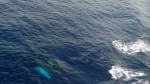
Back on board getting ready for dinner we raised anchor and sailed slowly and gingerly out through the whales still playing/fighting in the bay. We watched cameras ready and we were lucky, the ship sailed straight through a pod and I got a photo of mother and calf right below us, not a very clear one as they were under the surface, what a shame that what you can see clearly through the water, does not translate that well on a photo. Hopefully I will get it downloaded and Paul will post it. That’s it for today folks, tune in again for more news later.

Valentines Day at Sea

Friday 14th February

We are already 380 nautical miles from Lahaina sailing over underwater mountain ranges. The depth beneath our keel changes from 5,500 metres deep to just 1,000 metres and even less in places. One of these ridges is called the Seadragon Ridge, others less imaginatively called the Ironwood and Embattled seamount ridges. Apparently you can see them on Google earth, no matter how hard we look over the side we can’t see any.

Went to a talk on ‘Exploring the Solar System’ which was okay. It went from the time people thought everything revolved around the earth and all the false impressions different academics have had through the ages through all the discoveries to current thinking that the planets revolve around the sun. It got a bit more interesting when he left us with the question. Is this correct? and put up a video animation, showing our sun travelling through the solar system at 17,000 miles per second with our planets rotating round it, which then zoomed out to put it and us into perspective.

The ladies were presented with a red rose when they went into dinner today, I was waiting for someone to charge me a dollar. That’s what happened the last time someone gave Carol a red rose. Fortunately it didn’t happen this time or they would have got it back 😉 . Mary left hers on the table so I picked it up and presented it to Anna our waitress as we left, she was so pleased she gave me a kiss, didn’t mind that, but it was extra ice cream I was really after tomorrow. I’ll want the rose back if I don’t get it. Carol threatened to tell Laura. Anna wanted to know who Laura was, Nightmare! What was it Shakespeare said about tangled webs. I’ll keep you updated on the ice cream.

South Pacific

Saturday 15th February

We are now approaching the equator some 3,400 nautical miles from San Francisco and 1,185 miles to go to Pago Pago. (Remember? it’s pronounced Pango Pango). To port we have the Line Islands, one of which you will have heard. You may not immediately recall Kingman Reef, Palmyra Atoll, Teraina and Tauaran but you will of course have heard of Kiribati otherwise known as Christmas Island. One of Pago Pago’s claim to fame is it is the closest island to the splashdown of Apollo’s 10 12 14 17 and the ill fated Apollo 13. It seems that this part of the South Pacific has seen more than its fair share of excitement.

Two more presentations today, the second in the series of life beneath the waves (today on sharks and other scary sea creatures. She showed some clips of herself being attacked by various creatures whilst filming. One a moray eel (not a nice creature) which is why divers sing “If you put your hand in crack and you don’t get it back, that’s amoray”. Dale Templar gave her second presentation (with out-takes) on some of the more dangerous incidents and encounters she experienced during filming with the Humane Planet team. Which reminds me, if you remember, when were back ask me about their escapade in the African bush whilst filming the vet carrying out vasectomies on fully grown lions. It’s not a story that readily lends itself to a blog.

King Neptune’s Court

Sunday 16th February

That’s it then! we are now officially on the other side of the world; well, in the southern hemisphere and round the back so to speak, not quite twelve hours behind but tomorrow night clocks go back another hour and we will be eleven hours behind. Sailing along on a tranquil South Pacific sea not a ship to be seen in any direction, we could be miles from anywhere. Come to think of it, we are miles from anywhere. This morning I watched a talk by the military historian Aldon Ferguson on the formation of the American Eagle Squadrons from US volunteers defying their own government to become one of the highest scoring units of the period prior to the USA joining WWII. This was followed by 50 years of manned space flight, Carol went to another cooking demonstration.

Later we had the official crossing the line ceremony where a number of unfortunates before king Neptune’s court were tried, found guilty and rolled in spaghetti and other nasty looking gunge before being doused in the swimming pool. Carol went out to see what the fuss was about, I stayed inside and had a pint or two as the temperature was about 30°C. And I’ve seen what can happen to those who stray too close to the celebrations, best to stay well away.

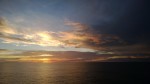
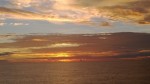
Ended the day watching the sunset from the balcony with a couple of drinks before going down for dinner.

Pago Pago

Tuesday 18th February

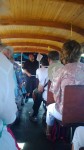
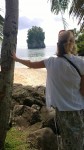
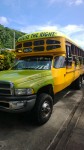
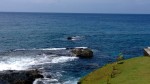
We arrived at the deep water harbour Tutuila which is not very wide for a ship the size of Queen Elizabeth, in fact as we sort of eased our way in we could hear dogs barking and cockerels crowing on shore. The inlet, surrounded by high cliffs covered in lush undergrowth which fall below the surface as deeply as they tower above us. Small buildings cling precariously to the cliff faces, mostly at about sea level but some brave souls have risked sticking buildings to the cliff face higher up. They sit there half enveloped in undergrowth, leaving one to wonder how on earth the milkman gets there each day. As we reach our berth the overriding impression is one of complete silence as once more we are surrounded on all sides by towering tree covered steep slopes rising to almost vertical upper reaches. It is not long before we are once more ashore, walking through the impromptu market that was convened to welcome us, to the gates of the small dock area manned by local police dressed in the traditional “skirts” though I guess they have a proper name for them (kilt maybe – perhaps not). Our ‘coach’ was waiting for us. Coach is perhaps too grand a word for it, as it was a traditional island bus with beautiful polished wooden bodywork that had flames painted on each side (presumably to give it the impression of a speed it did not have), fully air conditioned in the manner of this part of the world (no windows) which also doubled as our escape hatches in case of accident. Or so Kelvin our guide told us. He advised us that the air conditioning was fully adjustable, all we had to do was use the coaches’ communications system to let him know if we were too hot or too cold and he would advise John (the driver) to speed up or slow down accordingly. He was a Samoan of ample proportions who was also a paramedic. He advised us that the bus was fitted with an airbag pointing to himself and the modern communications system he spoke of (which we could also use to tell him to speak up) was a length of string stretching from front to rear, which if pulled produced a sort of strangled squeak. Seats were wooden planks covered in a thin red oil cloth and placed closer together than Ryan Air could ever dream of achieving. Kelvin said that we would not need seat belts as the coach didn’t go fast enough and we were so tightly packed in no one would move anyway. Suitably briefed on all aspects of our transport, we set off in a series of lurches and bangs, the air conditioning came on and Kelvin launched into his well-rehearsed commentary. We followed the coast road round to our first stop which was opposite a small island they called Flower Pot Island on account of the fact that it looked like a flower pot (why else). According to Kelvin the reason the island was there was a very complicated love story that included cannibalism, princes and princesses which would take far too long to relate here. However as we approached the island, there was an ominous load banging noise from underneath and the poor old bus came to a premature halt in a layby opposite Flower Pot Island. Whilst John called the bus hospital we sat under the coconut palms and took photos of the sea, the island, the bus and each other, until a replacement bus turned up. The replacement was slightly more the worse for wear that than the first, but with fully functioning air conditioning. We were soon on our way with a new driver called Lotto, apparently the driver goes with the bus so hopefully with a name like Lotto we should be OK. The rest of the trip went without incidence and we were shown the runway, sorry international airport (two flights per week), the golf course, a church and many more places of which the islanders are extremely proud. The scenery around the coastline is stunning, so to hear that the population of Samoans is shrinking was a surprise. On our return to the ship we stumbled on board to freshen up and have a bite to eat before nipping ashore again to McDonald’s (I know, I know) but it’s the only place with WiFi. We got caught in one of those torrential tropical rain storms which could have passed for a hot shower if we’d had some soap and anyway we shouldn’t have bothered, as so many others had the same idea that we were not able to log on when we got there. So we made our way back, had a proper shower and watched from the balcony as we executed a perfect standing 180° turn in the small space available and with many a blast on the ships sirens, bid farewell to the extremely friendly islanders.


Download Video

Who stole Wednesday?

Thursday 20th February

Who stole Wednesday that’s what I want to know? One minute we are going to bed on Tuesday evening and the next we are getting up on Thursday morning. Somebody just stole Wednesday! I didn’t have that much to drink that I slept right through. And another thing, when we went to bed we were eleven hours behind the UK and now we are thirteen hours ahead of you. When did that happen? Confused? You bet! Someone did steal Wednesday though. We never had it at all, no breakfast, lunch or dinner. Gone, just like that, gone! It’s not as if we have any Liverpudlians on board who we can blame. And it’s no good complaining, it’s not like they can give you another one, a spare that they just happen to have hanging around in a drawer or something. Puts you all out of sorts something like that, they’ll nick anything these days. Anyway what’s one day out of 120? Just as long as they don’t go making a habit of it and doesn’t happen again, I’ll say no more.

It’s continuing to get hotter. Stepping out on to the pool deck today was like stepping into a pizza oven, I’m surprised the pool hasn’t evaporated. Everywhere you look there are people basting themselves in variously flavoured oils and rotating slowly, roasting themselves evenly on this giant barbeque that doubles as a ship. Makes me look rather nervously at the menu come dinner time. Even the sea is too hot to wave it’s just lying there exhausted, flat, languid, hardly got the energy for a ripple.

We went to a talk by Dr Ingrid Visser who posed the question, who would win if a shark and a killer whale met? The answer is, the killer whale (or Orca to give it its proper name). Apparently they eat sharks for breakfast and any other meal come to that. She has only just provided evidence in the form of film to show how they do it. They swim past the shark avoiding the dangerous end and just as the shark is relaxing, thinking it’s safe the Orca karate chops the shark with it’s tail and then starts to munch it while it’s dazed. Some of the video footage was brilliant. She showed some shots of one shark (related to the Great White) that was so scared it tried to hide behind her in the water. The Orca was having none of it and ferreted it out and decked it, whereupon the shark then tried to get into her boat to escape. We were also told that there is no known incidents of a Killer whale attacking a human, except in captivity. Oh and we are going to get a preview of the film she’s made for the BBC (amongst others) before it’s shown on the networks.

Nuku’alofa, The Kingdom of Tonga


Friday 21st February

The approach to Nuku’alofa in the Kingdom of Tonga was different to all the other islands, in that we first saw the odd tiny rock showing above the surface of the sea, followed by what seemed to be an occasional bush growing from the surface of the sea. Very odd! Then clumps of bushes, then a few trees surrounded by bushes until everywhere we looked there were tiny tufts of bushes with the odd palm tree on. One or two islands were like the cartoons you see of a shipwrecked sailor sitting with his back to a single palm tree, only of course there was no shipwrecked sailor, or not that we could see in the early morning light, just a single lonely palm tree waiting for a sailor to sit under it. The islands got larger the closer we got to Nuku’alofa. It was quite a sight as the shallows or reefs and shoals extend about four nautical miles from the port. Approaching Nuku’alofa, we passed the Royal Palace looking for all the world like Southfork (Dallas! Remember?), except it had the Tongan flag flying from the centre tower over the front door.

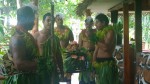
We berthed at a brand new pier (paid for by the Chinese) only a third the length of the ship, in a tropical downpour and to greet us were twenty or so Tongan singers and dancers performing a welcome dance. Their drenching didn’t dent their enthusiasm one jot and in fact it made their harmonised lilting melody all the more heart-warming as it soared up to us through the sound of the torrential rain. We stood and watched the whole performance, cheering them to the rafters (well the leaden clouds) before going down to muster for our tour of the Island. As we left the ship, the rain had slowed to a light shower and the Tongan Police band had replaced the dancers, but they were playing under a gazebo.

We boarded our coach which was parked in an inch of water courtesy of the deluge and our guide for the day Dianne apologised for the weather so delightfully it was if she had been personally responsible. She welcomed us to the Kingdom of Tonga and talked us through the programme. First stop the Royal Palace the one we sailed passed on our way in. The Queen Mother lives there now. Apparently the King lives in his own pad somewhere else on the Island. We stopped for a photo (just as they do at Buck House) and as we stood in the light rain we could hear the Police band across the bay doggedly playing “In the mood” which raised a few smiles. We then drove on to the royal tombs not quite Westminster Abbey but we get the drift. Lots of white and impressive statues of long departed Kings.

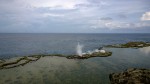
On we drive, through neat neighbourhoods with garden plants many UK gardeners would die for, but (unlike the UK), pigs seem to be the pet of choice, until we learn that they are usually kept for suckling pigs, a local delicacy we were to sample later. We arrive at the blow holes, a phenomenon that appears on many of these islands. As the sea wears away the coral shoreline below sea level small holes to the surface become exposed and each incoming wave forces either air or water through the hole at a pressure that either creates a geyser or a whistle or a mixture of both. Good fun, but in concentrating on waiting for the next wave we almost missed two pods of dolphins that had come to see what all the tourists were looking at. Whilst at the blow holes we wandered round the little stalls that seem to accumulate wherever tourists gather and one of the stallholders had a baby piglet on a lead quite cute until you remember why.

Talking of cute, the tiny children had a good little business going there. When a coach pulled up they all ran from the various stalls their parents had, not to the coach, but to a couple of benches where they sat and sang a mixture of Polynesian and western children’s songs whilst one of them strummed a tiny guitar. The little cardboard box in front of them soon filled up with dollars. I have to admit I chucked a couple in, but the old ladies chucked more, they were ooing and aahing for as long as the songs kept coming. As soon as the children showed signs of stopping more dollars flowed. Wish I’d thought of that when I was a choir boy.

Anyway onwards and upwards as someone once said and we moved on to the part of the island where the Flying Foxes were. We were told that these are not native and are only on the island because an ancient King won a canoe race and was given one as a prize. He brought it back to the island in triumph and they now have hundreds (don’t ask, the same thing ran through my mind but I didn’t want to embarrass Dianne by asking). We were informed that only Royalty were allowed to touch them and looking up at them I couldn’t help thinking they were welcome. They shoot and eat them, sounds like some other royals I know of. They taste like – yes you’ve guessed – chicken!) They are quite large about the size of a rook (apart from the wings which are larger and are bats wings) and unusually for bats they are extremely active during the day. They only eat fruits though so your blood is safe. Carol and one or two others spotted some huge spiders hanging from the telegraph wires, that had bodies the size of golf balls, Mary wouldn’t get off the bus because of them. One of the most common tree we saw turned out to be the breadfruit tree, about the size of a fully grown sycamore tree and covered in fruits the size of mangoes, we were told they fruit all the year round and are the staple diet of many families. We tasted some at the feast and whilst not at all unpleasant you wouldn’t want to eat them every day no matter how many different ways there are to prepare them. It reminds you that no matter how idyllic a place looks, to some of the people who are born and live there, it’s just the place where they struggle to survive, which makes our final destination seem all the more of a privilege.

We arrived at what was referred to as the resort, which turned out to be a large Polynesian eating/drinking/dance area, tiered and open on two sides. Here we were to lunch and watch a show which depicted the Tongan traditional dances and customs. After a welcoming drink (locally brewed beer, quite good and not at all like lager) we watched as the ceremony of bringing in the suckling pig was performed. It was, I hasten to add, fully prepared and cooked by this stage even though it still looked exactly like the little piglet we had seen earlier at the blow holes. It was carried in on something like a stretcher covered in leaves and flowers, by four chanting ‘Warriors’ who halted every few steps to perform some kind of ritual. The suckling was carried through to the banquet table where it was given pride of place. Following the ceremony we all took our plates to be loaded up from the myriad of local specialities on offer, things like Taro, Sweet Potato, Bread Fruit and Clams as well as the more conventional foods like Chicken, Tuna and mixed don’t know what’s, but all cooked in a Tongan style. The final piéce de résistance to the already loaded plate was a chunk of the suckling pig. During the meal we were entertained by a group of local musicians and singers who were later to accompany the dancers. After the remnants of the meal were cleared away we watched the Polynesian dancers perform their traditional dances. The warriors with their Hakka style and the girls with their exaggerated swaying hip moves, accompanied by the close harmony South Pacific style singing, though the first dance the girls performed whilst sitting cross-legged on the floor and was similar to the hand jive but a lot more elegant. I’m not surprised that Captain Cook’s men were so captivated they didn’t want to leave the Island and it was in this area the famous mutiny on the Bounty took place. By the way the name Nuku’alofa translates as nuku meaning abode and alofa meaning love. Nothing more to be said there then.

When we arrived back at the ship the police band were back to play us away, manfully working their way through their entire play list. The jetty became one large party area and when lady in red was played, one of the Aussies grabbed a local girl in the traditional red kimono style dress and danced with her, to huge applause and her huge embarrassment. After a lot of effort by ships security to get everyone on board, encouraged by some prolonged blasts on the ships sirens, the gangway was finally hauled up and we began to slowly inch ourselves away from the quay. Crowds lined the shore and the jetty waving, sirens blasted out farewells, and the police band struck up with the song I think from South Pacific, but the chorus the crowd were singing had the line ‘While you are sailing far across the sea. Please remember me’

Those Tongans know how to make you feel welcome.

We don’t have to eat the horses

Saturday 22nd February

Out on a flat calm South Pacific again, we looked out at the early morning sea that was like a highly polished, hammer finish, silver tray. It felt like we were becalmed as the ship slipped so quietly and smoothly through the water. It’s hardly changed all day except for tiny ripples stirred by the occasional slight breeze. The sailors of old called this the horse region. Because of the light (or lack of) wind, sailing ships could spend weeks trying to get through to more favourable conditions, so much so that they became very short of rations so the valuable horses had to be sacrificed to ensure survival.
At 11:30pm I went up on deck along with a couple of hundred others for a star gazing session given by Howard Parkin who will be giving his final talk (on Mars) tomorrow. The upper deck lights were turned off and there was hardly a cloud in the sky so we had a great view of the southern hemisphere sky. Using a laser pointer Howard pointed out all the constellations talking us through stars and planets the mythology behind many of them. Although I have been in the southern hemisphere before I had never been able to identify the Southern Cross before and it turns out there is a fake cross much larger than the true Southern Cross which as its name suggests, is often mistaken for the real one. When you have someone who can talk at length about the sky at night and can point as accurately as a laser allowed him to, it made all the difference about what you are looking at especially under a sky that is not familiar to you. We could have stayed much longer but as the moon began to rise, its brightness drowned out the visibility of all but the brightest stars. So we called it a night.