Monday 24th February
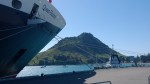
The approach to Tauranga was as nice as Tauranga turned out to be. We sailed past what seemed to be an endless beach that extended back to a thickly wooded plain, which in turn extended back to a long sharp jagged mountain ridge which resembled an ancient flint tool set in the ground. As we sailed slowly along the coastline, the ridge slowly descended and gave way to rolling hills and when we rounded a broad sandy spit and entered the bay the town of Tauranga appeared, spread right around the flat plain in front of the encircling hills. Captain Cook called this area the bay of plenty before he set foot ashore and you can understand why as you look at the landscape. It seems to be in the perfect place to capture the sunlight and be protected from winds by the hills. The early settlers said that you only had to tickle the soil for anything to grow,
After one of the swiftest disembarkations yet, we made our way to a Kiwi Fruit orchard (Kiwi360) where we were shown the fruit growing from vines in abundance. The vines are not irrigated, their roots descend deep into the volcanic dust sub soil that lies beneath the sand topsoil. Each plant transpires 60 litres of water a day through their leaves alone before taking into account that required to form each fruit, of which there are hundreds on each plant. The micro climate in this area coupled with the perfect soil conditions mean that the fruits they grow are amongst the best in the world but very few make their way to the UK or the US because the current poor exchange rates make it unprofitable. The orchard grew every type of fruit and nut you could think of, Avocado, Almond, Pear, Cherry, Lemons, Oranges, Pistachio, but many of these were not even harvested as margins were so good on Kiwi and labour is so short that Kiwi remains the priority. Because labour is so short no one is entitled to the dole during the three harvest months as there is more work available than people to fill the jobs, so no one needs to be out of work. All around the area are fields of Maize and other crops and in between fields of Frisian (incidentally they are moving to dairy from sheep as there is so little margin on Lamb). We finished up at The Elms which was the old mission centre where the early missionaries set up shop bring Religion to the Maori population who were busy happily fighting amongst themselves and saw no reason to stop. When the settlers arrived and took the Maori’s land, they got a bit cross as you can imagine and challenged the British army to a fight which the 68th Durham and 43rd Monmouth light infantry agreed to with relish. They collectively agreed that the ‘fight’ would take place on 29th April 1864 at Gate Pa in Tauranga, whereupon the 68th and the 43rd got their collective bottoms well and truly spanked, despite having a numerically much larger force. This great victory by the Maori over the British was all the more conspicuous for the acts of kindness shown by the Maori to the British wounded afterwards. But in the end it all ended in tears for the Maori, as these things always do and two months later the British, having got their act together, inflicted heavy losses on the Maori at nearby Te Range and the land war was over. Settlers take all Maori get nothing. Still it’s not all bad, it seems that things have improved recently as since 1985 financial reparations have been made to a number of Maori tribes and they have been “allowed” to buy land and “invest” in education. But to give the Maori’s their due they don’t seem to have taken it to heart and now live in peace and harmony with the settlers.
It is easy to see why, driving along (on the left) we could so easily be somewhere in the UK. The weather is temperate, the countryside beautiful and the town is immaculate and it is not hard to understand why people are so content here. Fifty or so years ago it was a holiday resort, today it is the fastest growing city in New Zealand and has crept into the top ten as the ninth largest. More and more people visited and stayed, firms began to relocate which attracted yet more people. Land reclamation began for the docks and associated industry until it became what it is today, a thriving town.