Saturday 15th March
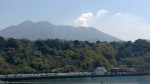
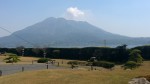
We arrived in Kagoshima to a welcoming crowd of Japanese well wrapped up and madly waving little orange flags like their lives depended on it. An excellent band played their hearts out as we berthed at a brand new liner terminal on a huge rectangle of reclaimed land. The terminal took about a 1% of the available area that had been reclaimed which looked a bit incongruous as this strip had been landscaped (including mature trees) whilst the remaining 99% was white compressed hard core with a frame of reinforced concrete, most of which was currently being used as a temporary car park for the assembled crowd. The backdrop to this visage was the city of Kagoshima, scrunched together at the base of a mountain range that looked like it was deliberately nudging the whole community into the bay. In fact as we were to learn later, the whole population of Japan of over one hundred million souls inhabit just 5% of the country that is available, most of it similarly surrounded by mountain ranges like the one surrounding Kagoshima. On the far side of the bay nestling in amongst a dozen or so peaks we espied yet another smoking volcano. I wondered if that was Sakurajima. Impressed that I know the name of Japanese volcanoes? Don’t be, Sakurajima is the destination of our trip today and as it is a volcano it was a safe bet that, this was the one. I am not sure how wise it is climbing the side of Japan’s most active volcano, but if my blog stops here then you will know it turned out to be not at all wise.
Immigration turned out to be the usual scrum with the queue going twice round the ship (or so it seemed) and like the Americans, the Japanese wanted everyone’s finger prints, though their fingerprint machines proved far more temperamental than the American ones. The times allocated for everyone to attend were quickly ignored by most passengers. Those going on trips jostled with those due to leave the ship at this port as their departure times loomed large. Harassed ships staff attempting to improve things by changing instructions and fast tracking these passengers only succeeded in raising the ire of those who had been assiduously queuing for an hour or more. Once more we were reminded of how effectively and efficiently immigration was achieved when immigration officials sailed with us from the port prior to entry. One can’t help wondering how a company with the experience Cunard have, keep getting caught with their pants down by immigration procedures. Everything else they organise seems to run like clockwork. Luckily we were near the front of the queue and our tour was only delayed 30 mins because of those caught in the mêlée. The main complaint we heard, was as always, lack of information, though I suspect the reason information was not forthcoming was because the delays were caused by difficulties with the fingerprinting devices and to broadcast this would only serve to embarrass our hosts. I was efficiently processed, my finger prints were taken by a pretty young girl who was very apologetic when her equipment didn’t work, she wiped my fingers with a pad and kept saying push harder sir, push harder! which I did and finally when she was satisfied she cleared me for entry.
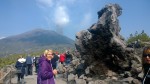
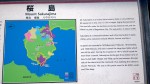
We disembarked into a beautiful sunny spring morning and boarded our coach. We had a delightful tour guide called Hiroko who’s English was excellent and her knowledge of the ancient history of the area prodigious. She introduced us to our driver Mr Sugarshitta who was more smartly dressed and smiled more than any military man I have seen and off we went into? Yes you’ve guessed, traffic. We think we have bad traffic but Japans traffic is different, it flows like toothpaste, very smoothly, but very slowly. We sort of oozed along rather than flowed, which is why we were grateful for Hiroko who worked valiantly at keeping us informed and entertained. Remarkably for a high-tech country, her presentation aids were decidedly low tech. She had hand drawn in felt tip pen her pictures to describe the subjects she was talking about (inadvertently showing us a drawing of a Buddha upside down, which we all thought was deliberate, a sort of Buddha doing yoga). Her map of Japan which was stuck over the TV kept falling down and the Cunard lady volunteered to hold it up while Hiroko used an unnecessary extending pointer to indicate the areas she was talking about (a finger would have worked just as well), I loved it. We eventually turned up at the ferry which we drove on and ten minutes later drove off at the ferry terminal on Mount Sakurajima. Now people say Mount Sakurajima is impressive from a distance (and it is) but up close it is not! It’s alarming, there is a steady rain of ash which we were told was nothing to worry about as the volcano was behaving itself today. From the state of the cars parked outside it was hard to believe, they looked like they had been parked there for years. We wandered around the paths below the main vent which was about a 1000 metres above and realised that the noise we were listening to was not the wind, but gas hissing; no roaring out of what looked to us like a very small crater. Anyone who has heard a pressure cooker hissing will know the feeling. Unbelievably this volcano has erupted 830 times in the previous twelve months, (it is the world’s most active volcano) it sounded like it was about to go again when we were there, but all that was happening was puffs of smoke and ash like a contented pipe smoker sat by his Tele. 5,000 people live on the island and they have an ash collecting service, we think we have enough different coloured bins, but if you live on the island you place all the ash you sweep up in yellow plastic bags which you place outside in a little covered area to be collected. Everywhere we went there were little shelters not unlike an Anderson shelter (that ages me) but constructed in cement, just in case there was a belch, because then the volcano spits out rocks as well as dust and these are a bit dangerous if they land on your head. I picked one up (about the size of a small plum) and they are not light. The islanders were not only happy to live there, they were proud of the produce they could grow in the ash. Giant radishes were their best produce, apparently one of their radishes appears in the Guinness Book of Records as the largest radish ever grown, but everything else grew better, sweeter and bigger. Makes you think that there is a market for the ash as a growth enhancer. Anyway after tasting the radishes and the tiny sweet oranges and the baked sweet potatoes it was time to bid farewell to the world’s most active volcano and we drove onto the ferry and back across the Bay (which by the way was created by? Yes you’ve guessed it a volcano, about three thousand years ago). On the way back Hiroko informed us that she had forgot to sing the song she was supposed to sing to appease the volcano on the way there, but she would sing it now on the way back, which she did. A delightful little ditty in the manner of all Japanese songs, ie not easy to join in with, however it got a round of applause which pleased her. Next stop was Sengan-en Garden which was three hundred years old and used to belong to the ruling samurai. As we pulled into the car park we were directed into our bay by a young lady in another very smart uniform and a very loud referee’s whistle, which she used as a reversing signal. As we reversed in she gave intermittent long blasts on the whistle which shortened in length and increased in number the closer we got to the wall, upon reaching the desired position this changed to a long steady blast. Japan the home of all the latest gadgets in cars was still using someone with a whistle to reverse coaches into bays, perhaps they have a very powerful car park attendants Union.
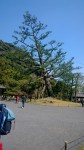
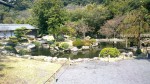
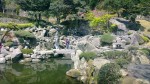
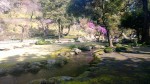
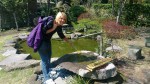
They were very proud of this garden which used something they called ‘borrowed scenery’ using Mount Sakurajima as a garden hill and Kino Bay as a garden lake. I think Capability Brown called it Landscape Gardening. Everything was immaculate, the lawns, rockeries, hedges you name it. But there was some strange incongruities, for instance high up on the hillside was some Japanese writing on a big piece of cliff face which Hiroko explained was put there by an ancient samurai as a joke. He had 4,000 workers carve the cliff flat and then engraved the characters ‘THIS IS BIG’ Well I don’t suppose anyone told him it wasn’t funny because samurais could get a bit nowty if you didn’t laugh at their jokes. But I couldn’t help wondering what the 4,000 workers thought about having to carve what was after all, ancient graffiti and not very good graffiti at that. There’s nothing new in the world of vandalism. We spent a good hour or so wandering round appreciating things like the 300 year old falling down tree, a statue of a lion standing on its head (another ancient samurai joke) we tasted a local drink made of vinegar and honey, it tasted of vinegar and honey (another ancient samurai joke? No, but it tasted like one) it was supposed to do you all sorts of good. We asked Hiroko if we could taste some Saki she said no but she knew a song about that and bolstered by the success of the previous song, she sang us the song of Saki, which sounded a lot like the previous one, except we could hear the odd mention of the word Saki in it.
On our way back as we oozed along in the traffic Hiroko once more launched into her routine of facts and figures about Japan, it was amazing the sheer magnitude of information she had stored in her head. Of course she could have been making it up but I doubt it as it was obviously a passion. She explained the difference between a temple and a shrine (Buddhists worship in a temple and Shinto’s worship in a shrine) and explained the paradox of the total number of Buddhists, Shinto’s and Christians’ in Japan totalling about 250 million. Japanese love festivals, especially Christmas, so to be able to take part in all of them, they worship and take part in all three religions. Someone asked her when the Cherry Blossom bloomed? Big mistake! Some of the early blossoms were blooming already, but she explained that the big burst of blossom would be in two weeks time. However she knew a song about cherry blossom which she proceeded to sing. This song was quite a bit longer than the previous two songs so it was quite a relief when she got to the end, unfortunately she also knew it in English so she then sang the whole song again in English! Sigh! Perhaps we should not have applauded her singing so enthusiastically, Hiroko was obviously not into irony.
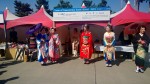
When we got back to the ship the quay was crowded and there was a strange thundering noise which we finally tracked down to some traditional Japanese drummers who were bashing their drums quite ferociously, so took a couple of videos, then we had a look round the rest of the stalls that were set up, kimono wearing ladies and traditional dancers. They were all having a great time and cars were still pouring into the car park. Chairs were being put out for what looked like a fully fledged orchestra and about half an hour before sailing this turned out to be so, except for one thing all the players were school children and they really were superb. They played Glenn Miller numbers and the soloists, both boys and girls displayed a maturity way beyond their years and they played a large selection of his repertoire. As we cast off and reversed away from the quayside a huge cheer went up and there was once more a mass of madly waving orange flags. The band broke into “In the mood” once more and the ships foghorn let rip with a series of farewell blasts.
Drummers - 55MB