Thursday 6th March
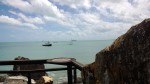
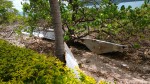
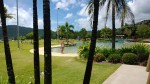
We woke shortly before anchoring in Pioneer Bay on what was Queen Elizabeth’s maiden call to Whitsunday Island some 700 miles to the north of Brisbane and, contrary to what we had been told, we found ourselves 6 nautical miles off Airlie Beach, quite a trip ashore. Not to worry, instead of the ships tenders (holding about eighty people and travelling at about 7 knots) we had local catamarans holding some three hundred plus and travelling at 22 knots. We waited for the initial rush to subside which in 300 tranches took no time at all. Airlie Beach is a small town (population 4,000) with no building older than 35 years but it is the gateway to the 74 Whitsunday Islands and the Great Barrier Reef so is an important tourist town with all the facilities of such. It is a major yachting and boating centre as well as having many hotels, back-packers accommodation, holiday apartments and camping sites. The town has a very new look about it with pristine facilities, a bathing lagoon just above the beach which at first sight seems superfluous as it was immediately adjacent was a very attractive beach, until that is, we read the notice about the dangers of stingers (or jelly fish as we know them) some of their stings can be fatal and the season for them stretches from November to May. Incredibly there were people swimming. But for all its superficial attractions there was the odd sinister hint that conditions were not always as tranquil. Passing along a boardwalk through some mangroves we spotted the bow section of what was once a very expensive catamaran or a very sleek yacht and not very old as the glass fibre broken edges were pure white and the metalwork was still gleaming. It would have taken some powerful waves to get it embedded as far into the mangrove as it was and once our attention was drawn to it we began to notice other storm detritus that they had not been able to clear away. It would appear that there is a price to pay for living in paradise and in this part of the world that price is set and levied by the forces of nature.
We spent a very enjoyable few hours in Airlie Beach culminating in a pint or two in a Bar overlooking Pioneer Bay which was where I first noticed something odd about the ship. It was still very much in the same position as when we disembarked, not I hasten to add, that I expected it to have sailed or anything, but the tide had clearly turned whilst we were ashore and the ship hadn’t. Furthermore the wind was on the port beam so even if the tide was not sufficient to shift her the stiff breeze should have, very odd, especially as when we returned on board it was clear that not only was there a strong tide but the wind on the port beam was causing a list of a degree or so to starboard. So I wandered down to deck 3 to see if they had a stern anchor set that could account for this. But it was simpler than that. The ships engines were running, the starboard pod was pointing to starboard countering the pressure bought by the wind, and the port pod was countering the pressure bought by the tide. I have never been on a ship that kept her engines running whilst anchored before, but it is probably to avoid the destruction of sea bed coral, I’ll let you know if I find out. One very disappointing aspect of this part of Australia is the sea. I had expected it to be crystal clear, but it is opaque, almost milky in appearance so no chance of seeing the coral (even in a glass bottomed boat) again I’m not quite sure what the reason for this is but if I find out I’ll let you know.
Wednesday 5th March
Navigation in this part of Australia is tricky to say the least. Most of the sea bed is covered in protected coral where is even illegal to drop anchor due to the damage it inflicts on the sea bed, not so much the anchor itself but the long length of chain that is laid out on the sea bed after the anchor is dropped. As the tide turns and the ship swings round into its new position, it drags this chain round, crushing and damaging a huge circle of coral that’s taken hundreds of years to grow. When you get hundreds of ships dropping anchor, you begin to realise the scale of damage this creates. So for all the smaller boats that want to spend the night in a particular anchorage the reef authorities have provided buoys to moor to free of charge. The majority of people here are extremely careful about the reef so it tends to be self-policing. Last night we retraced our wiggly course out of Brisbane, re-entering the Pacific Ocean and turning North then North West into the Capricorn Channel which led us into the Great Barrier Reef (not the sort of place you want to wander without a pilot) and so for the whole time we are in the GBR we will have a pilot on board.
We went to the first of a series of talks by a forensic dentist on some of the cases she has been called to help solve from bite mark evidence. More gruesome crimes and fascinating switches in cases brought about by bite marks or not (as in the case where the marks turned out to be crayfish bites as the body had been in water for 24 hours). Not really a job I’d relish doing, looking forward to her other talks.
Towards the end of the day we were heading into Whitsunday Passage which leads us to Pioneer Bay where we will anchor off. Yes I know! but more about that tomorrow.