Monthly Archives: February 2014

Nuku’alofa, The Kingdom of Tonga


Friday 21st February

The approach to Nuku’alofa in the Kingdom of Tonga was different to all the other islands, in that we first saw the odd tiny rock showing above the surface of the sea, followed by what seemed to be an occasional bush growing from the surface of the sea. Very odd! Then clumps of bushes, then a few trees surrounded by bushes until everywhere we looked there were tiny tufts of bushes with the odd palm tree on. One or two islands were like the cartoons you see of a shipwrecked sailor sitting with his back to a single palm tree, only of course there was no shipwrecked sailor, or not that we could see in the early morning light, just a single lonely palm tree waiting for a sailor to sit under it. The islands got larger the closer we got to Nuku’alofa. It was quite a sight as the shallows or reefs and shoals extend about four nautical miles from the port. Approaching Nuku’alofa, we passed the Royal Palace looking for all the world like Southfork (Dallas! Remember?), except it had the Tongan flag flying from the centre tower over the front door.

We berthed at a brand new pier (paid for by the Chinese) only a third the length of the ship, in a tropical downpour and to greet us were twenty or so Tongan singers and dancers performing a welcome dance. Their drenching didn’t dent their enthusiasm one jot and in fact it made their harmonised lilting melody all the more heart-warming as it soared up to us through the sound of the torrential rain. We stood and watched the whole performance, cheering them to the rafters (well the leaden clouds) before going down to muster for our tour of the Island. As we left the ship, the rain had slowed to a light shower and the Tongan Police band had replaced the dancers, but they were playing under a gazebo.

We boarded our coach which was parked in an inch of water courtesy of the deluge and our guide for the day Dianne apologised for the weather so delightfully it was if she had been personally responsible. She welcomed us to the Kingdom of Tonga and talked us through the programme. First stop the Royal Palace the one we sailed passed on our way in. The Queen Mother lives there now. Apparently the King lives in his own pad somewhere else on the Island. We stopped for a photo (just as they do at Buck House) and as we stood in the light rain we could hear the Police band across the bay doggedly playing “In the mood” which raised a few smiles. We then drove on to the royal tombs not quite Westminster Abbey but we get the drift. Lots of white and impressive statues of long departed Kings.

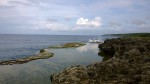
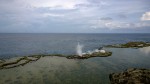
On we drive, through neat neighbourhoods with garden plants many UK gardeners would die for, but (unlike the UK), pigs seem to be the pet of choice, until we learn that they are usually kept for suckling pigs, a local delicacy we were to sample later. We arrive at the blow holes, a phenomenon that appears on many of these islands. As the sea wears away the coral shoreline below sea level small holes to the surface become exposed and each incoming wave forces either air or water through the hole at a pressure that either creates a geyser or a whistle or a mixture of both. Good fun, but in concentrating on waiting for the next wave we almost missed two pods of dolphins that had come to see what all the tourists were looking at. Whilst at the blow holes we wandered round the little stalls that seem to accumulate wherever tourists gather and one of the stallholders had a baby piglet on a lead quite cute until you remember why.

Talking of cute, the tiny children had a good little business going there. When a coach pulled up they all ran from the various stalls their parents had, not to the coach, but to a couple of benches where they sat and sang a mixture of Polynesian and western children’s songs whilst one of them strummed a tiny guitar. The little cardboard box in front of them soon filled up with dollars. I have to admit I chucked a couple in, but the old ladies chucked more, they were ooing and aahing for as long as the songs kept coming. As soon as the children showed signs of stopping more dollars flowed. Wish I’d thought of that when I was a choir boy.

Anyway onwards and upwards as someone once said and we moved on to the part of the island where the Flying Foxes were. We were told that these are not native and are only on the island because an ancient King won a canoe race and was given one as a prize. He brought it back to the island in triumph and they now have hundreds (don’t ask, the same thing ran through my mind but I didn’t want to embarrass Dianne by asking). We were informed that only Royalty were allowed to touch them and looking up at them I couldn’t help thinking they were welcome. They shoot and eat them, sounds like some other royals I know of. They taste like – yes you’ve guessed – chicken!) They are quite large about the size of a rook (apart from the wings which are larger and are bats wings) and unusually for bats they are extremely active during the day. They only eat fruits though so your blood is safe. Carol and one or two others spotted some huge spiders hanging from the telegraph wires, that had bodies the size of golf balls, Mary wouldn’t get off the bus because of them. One of the most common tree we saw turned out to be the breadfruit tree, about the size of a fully grown sycamore tree and covered in fruits the size of mangoes, we were told they fruit all the year round and are the staple diet of many families. We tasted some at the feast and whilst not at all unpleasant you wouldn’t want to eat them every day no matter how many different ways there are to prepare them. It reminds you that no matter how idyllic a place looks, to some of the people who are born and live there, it’s just the place where they struggle to survive, which makes our final destination seem all the more of a privilege.

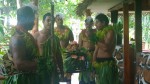
We arrived at what was referred to as the resort, which turned out to be a large Polynesian eating/drinking/dance area, tiered and open on two sides. Here we were to lunch and watch a show which depicted the Tongan traditional dances and customs. After a welcoming drink (locally brewed beer, quite good and not at all like lager) we watched as the ceremony of bringing in the suckling pig was performed. It was, I hasten to add, fully prepared and cooked by this stage even though it still looked exactly like the little piglet we had seen earlier at the blow holes. It was carried in on something like a stretcher covered in leaves and flowers, by four chanting ‘Warriors’ who halted every few steps to perform some kind of ritual. The suckling was carried through to the banquet table where it was given pride of place. Following the ceremony we all took our plates to be loaded up from the myriad of local specialities on offer, things like Taro, Sweet Potato, Bread Fruit and Clams as well as the more conventional foods like Chicken, Tuna and mixed don’t know what’s, but all cooked in a Tongan style. The final piéce de résistance to the already loaded plate was a chunk of the suckling pig. During the meal we were entertained by a group of local musicians and singers who were later to accompany the dancers. After the remnants of the meal were cleared away we watched the Polynesian dancers perform their traditional dances. The warriors with their Hakka style and the girls with their exaggerated swaying hip moves, accompanied by the close harmony South Pacific style singing, though the first dance the girls performed whilst sitting cross-legged on the floor and was similar to the hand jive but a lot more elegant. I’m not surprised that Captain Cook’s men were so captivated they didn’t want to leave the Island and it was in this area the famous mutiny on the Bounty took place. By the way the name Nuku’alofa translates as nuku meaning abode and alofa meaning love. Nothing more to be said there then.

When we arrived back at the ship the police band were back to play us away, manfully working their way through their entire play list. The jetty became one large party area and when lady in red was played, one of the Aussies grabbed a local girl in the traditional red kimono style dress and danced with her, to huge applause and her huge embarrassment. After a lot of effort by ships security to get everyone on board, encouraged by some prolonged blasts on the ships sirens, the gangway was finally hauled up and we began to slowly inch ourselves away from the quay. Crowds lined the shore and the jetty waving, sirens blasted out farewells, and the police band struck up with the song I think from South Pacific, but the chorus the crowd were singing had the line ‘While you are sailing far across the sea. Please remember me’

Those Tongans know how to make you feel welcome.
We don’t have to eat the horses

Saturday 22nd February

Out on a flat calm South Pacific again, we looked out at the early morning sea that was like a highly polished, hammer finish, silver tray. It felt like we were becalmed as the ship slipped so quietly and smoothly through the water. It’s hardly changed all day except for tiny ripples stirred by the occasional slight breeze. The sailors of old called this the horse region. Because of the light (or lack of) wind, sailing ships could spend weeks trying to get through to more favourable conditions, so much so that they became very short of rations so the valuable horses had to be sacrificed to ensure survival.

At 11:30pm I went up on deck along with a couple of hundred others for a star gazing session given by Howard Parkin who will be giving his final talk (on Mars) tomorrow. The upper deck lights were turned off and there was hardly a cloud in the sky so we had a great view of the southern hemisphere sky. Using a laser pointer Howard pointed out all the constellations talking us through stars and planets the mythology behind many of them. Although I have been in the southern hemisphere before I had never been able to identify the Southern Cross before and it turns out there is a fake cross much larger than the true Southern Cross which as its name suggests, is often mistaken for the real one. When you have someone who can talk at length about the sky at night and can point as accurately as a laser allowed him to, it made all the difference about what you are looking at especially under a sky that is not familiar to you. We could have stayed much longer but as the moon began to rise, its brightness drowned out the visibility of all but the brightest stars. So we called it a night.

Approaching New Zealand

Sunday 23rd February

Weather is beginning to cool somewhat as we continue to sail south, though it can hardly be called cold. The pool deck is still a bit of a scorcher and with hardly a breath of wind, more so. Later in the day more cloud began to accumulate and the wind began to coax small wavelets out of the flat calm so I guess we are beginning to get clear of the horse region.

I went to Howard Parkins talk on Mars which had a lot of good video and followed the history of the attempts to visit the planet and later we both went to the documentary ‘Blackfish’ which has uncovered some of the facts SeaWorld wants to keep secret regarding deaths of trainers and the conditions that Orca (Killer Whale) are kept in. Well worth watching if you see it scheduled, apparently it has already been shown on BBC 4. All extremely controversial stuff and SeaWorld have deep pockets. But Dr Ingrid Visser seems to be a feisty character and at the question and answer session after the film gave a good case for them to answer. We spoke to her on Friday morning at breakfast and she was very pleasant, willing to chat for as long as you wanted.

Anyway that’s about it for today, we are going to another Captains cocktails before dinner and tomorrow we are at Tauranga New Zealand.

Hawaii – Photos

Pago Pago – Photos

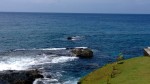
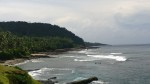
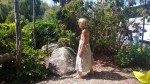
Nuku’alofa – Photos

Kiwi-land and Kiwi Fruit

Monday 24th February

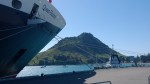
The approach to Tauranga was as nice as Tauranga turned out to be. We sailed past what seemed to be an endless beach that extended back to a thickly wooded plain, which in turn extended back to a long sharp jagged mountain ridge which resembled an ancient flint tool set in the ground. As we sailed slowly along the coastline, the ridge slowly descended and gave way to rolling hills and when we rounded a broad sandy spit and entered the bay the town of Tauranga appeared, spread right around the flat plain in front of the encircling hills. Captain Cook called this area the bay of plenty before he set foot ashore and you can understand why as you look at the landscape. It seems to be in the perfect place to capture the sunlight and be protected from winds by the hills. The early settlers said that you only had to tickle the soil for anything to grow,

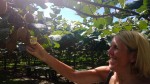
After one of the swiftest disembarkations yet, we made our way to a Kiwi Fruit orchard (Kiwi360) where we were shown the fruit growing from vines in abundance. The vines are not irrigated, their roots descend deep into the volcanic dust sub soil that lies beneath the sand topsoil. Each plant transpires 60 litres of water a day through their leaves alone before taking into account that required to form each fruit, of which there are hundreds on each plant. The micro climate in this area coupled with the perfect soil conditions mean that the fruits they grow are amongst the best in the world but very few make their way to the UK or the US because the current poor exchange rates make it unprofitable. The orchard grew every type of fruit and nut you could think of, Avocado, Almond, Pear, Cherry, Lemons, Oranges, Pistachio, but many of these were not even harvested as margins were so good on Kiwi and labour is so short that Kiwi remains the priority. Because labour is so short no one is entitled to the dole during the three harvest months as there is more work available than people to fill the jobs, so no one needs to be out of work. All around the area are fields of Maize and other crops and in between fields of Frisian (incidentally they are moving to dairy from sheep as there is so little margin on Lamb). We finished up at The Elms which was the old mission centre where the early missionaries set up shop bring Religion to the Maori population who were busy happily fighting amongst themselves and saw no reason to stop. When the settlers arrived and took the Maori’s land, they got a bit cross as you can imagine and challenged the British army to a fight which the 68th Durham and 43rd Monmouth light infantry agreed to with relish. They collectively agreed that the ‘fight’ would take place on 29th April 1864 at Gate Pa in Tauranga, whereupon the 68th and the 43rd got their collective bottoms well and truly spanked, despite having a numerically much larger force. This great victory by the Maori over the British was all the more conspicuous for the acts of kindness shown by the Maori to the British wounded afterwards. But in the end it all ended in tears for the Maori, as these things always do and two months later the British, having got their act together, inflicted heavy losses on the Maori at nearby Te Range and the land war was over. Settlers take all Maori get nothing. Still it’s not all bad, it seems that things have improved recently as since 1985 financial reparations have been made to a number of Maori tribes and they have been “allowed” to buy land and “invest” in education. But to give the Maori’s their due they don’t seem to have taken it to heart and now live in peace and harmony with the settlers.

It is easy to see why, driving along (on the left) we could so easily be somewhere in the UK. The weather is temperate, the countryside beautiful and the town is immaculate and it is not hard to understand why people are so content here. Fifty or so years ago it was a holiday resort, today it is the fastest growing city in New Zealand and has crept into the top ten as the ninth largest. More and more people visited and stayed, firms began to relocate which attracted yet more people. Land reclamation began for the docks and associated industry until it became what it is today, a thriving town.

Boats Planes and Jumpers

Tuesday 25th February

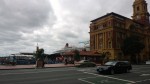
It was ‘nobbut a spit’ to Auckland from Tauranga as they say in Lancashire, or to put it in plain language, a very short distance. In the order of 150 miles. So it was not a surprise to wake up this morning and find that we had already arrived in Auckland the largest city in New Zealand and have been given pride of place in the town centre right opposite the old ferry terminal. Weather is perfect about 75°f [about 24°C for those of us who use proper units – Paul] and the sky full of cotton wool puffs of cloud. The Auckland skyline is not too overpowering as the majority of high-rise buildings are between fifteen and twenty-five stories high in the centre of the city with a sprinkling of smaller ones scattered around them to balance the effect. The further along the coast in each direction the lower the buildings.

We were off on a jaunt by 10:00am with our steerologist Paul (who honestly admitted that this was his first day on the job with comments like “jees this is bigger than my mini” but it turned out that he normally did cross country tours and it ‘really was’ his first day on the half day trips). pointing out all relevant points of interest with an extremely droll sense of humour which kept the whole coach entertained. The cathedral (a fairly modern looking building) was compared rather disparagingly as an Ikea cathedral, to the lovely old hand carved wooden one it replaced which still stands, but was moved to the other side of the road. Apparently because a lot of buildings are made of wood the New Zealanders make a habit of picking them up and shifting them elsewhere. Passing the television tower we craned our necks to see the people bungee jumping from the top without much luck, Carol said she saw one, but I’m not sure her eyesight is that good. We were taken to see where the wealthy lived in Auckland and before we got there Paul announced that we were about to see examples of how, just because an individual is blessed with a high net worth, does not necessarily mean they are blessed with good taste. Then mentioned that the people who lived there had asked for the tourist coaches to be banned from driving past their houses as they always seemed to be laughing. Not surprisingly as he then started to intone “oh! Honey I’d like to live in a house like a chocolate cake” as we drove past one that looked just like that. Then “oh! Honey I’d like to live in a house like a bunker” and so on, past the house that looked like a biscuit tin, a Neo Georgian manor house. He had a dry comment for every situation, but he knew his stuff for all that. Remind me to tell you about the Orange people, I don’t have time or space to tell you here. But it’s worth hearing.

On our way back down the hill we stopped and Paul asked for a minutes silence, as we all went quiet he asked us to look over the harbour and pay our respects, as it was there that the New Zealand Americas Cup team lost the cup to a landlocked nation. Switzerland! Sailing is a national obsession (there is one sailing boat to every four people here) and that was the ultimate humiliation.

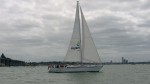
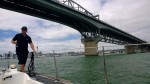
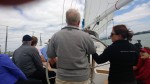
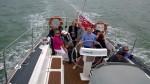
Talking of sailing, that was where we headed for next, back down to the wharf where eight of us boarded a fifteen metre sailing ship for a trip round the harbour. There was a respectable breeze and after motoring out from the quayside we hoisted the sail and off we went heeling over until we were all in heap in the bottom of the boat. Well, not quite, until that is I took the helm and then I heard some bumps and squeals behind me. Turns out that Carol had got over familiar with a Japanese couple as we were at a good angle and cracking on a bit. Things got a bit interesting when the seaplane (Alpha one) took off heading straight towards us drawing curses from the captain as they were supposed to be warned before take-off in order to steer clear. Over our heads she flew just missing us, honest! got it on video. Well it might have been a bit higher. As we sailed under the harbour bridge there was a piercing scream from above and a body plunged towards the sea. Hearts in our mouths we watched in disbelief as it headed vertically for the water and just as it reached the surface it shot straight back up again before once more plunging earthwards. This happened several times with decreasing intensity until the unfortunate victim was finally hauled back up towards the bridge. Bungee jumping! What is it with New Zealanders that they want to throw themselves of any available high structure?

All too soon time was up and we headed back to the quayside once more encountering the bungee jumpers and Alpha one, landing this time, more curses as again no warning until after she had landed in front of us. Again got it on video. Tying up alongside we headed off into the town wandered around the shops etc. Until it was time for Carol to go back on board, (she had a hair appointment) so I wandered off to find WiFi with a pub attached. Found one but it only sold lager and Guinness so I had a Guinness. Had a problem getting the WiFi to work but the little Chinese girl behind the bar sorted it out for me. What is it about young girls behind bars who can work your phone better than you can? WiFi was exceedingly slow but I did manage to get some pictures away. Won-she told me it was the Internet in New Zealand that was to blame not the bar. Had to leave without all the pictures going as we were sailing early 5:30pm so legged it back on board and as Carol was still sitting with her hair wrapped in tinfoil, I went up to the Commodore club for a pint to watch as we sailed from Auckland. With many a blast on the ships siren, we backed out and picked our way carefully through the thousands (or so it seemed) sailing boats that were zigzagging all over the place like demented water boatmen. Have they got a death wish or what? We are a big ship and they disappeared from our sight beneath the bow on occasion. Carol finally turned up and I got the look when I asked as casually as I could “Oh were they closed?” Had to buy a cocktail for that little aside, when will I ever learn?

Trumpets and Canoes

Wednesday 26th February

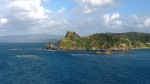
The Bay of Islands is another 150 miles north of Auckland and is a truly beautiful part of North Island with a plotted 142 islands around a coastline of bays and long silvery beaches. Captain Cook named it the Bay of Islands but New Zealand was first visited and named New Zealand after Zealand in Holland, in December 1642 by the Dutch Explorer Abel Tasman. I share this with you not as a history lesson, but for some interesting facts behind his discovery. He never set foot on land, his two ships anchored off in the Bay and the local Maori’s seeing these strange vessels arrive, sounded an alarm on an instrument that looked like a short didgeridoo and made a sound not unlike a trumpet.

It turned out that someone on one of the ships actually had a trumpet and thinking he could do better than that, let rip with a rendition of ‘Oh My Papa’ or the 1642 equivalent. Well! what the unfortunate Eddie Calvert wannabe didn’t know, was, whatever he played, was effectively a declaration of war to the Maori, a sort of musical equivalent of “Oi! come over ere if you want some!” Talk about red rag to a bull, Maori’s everywhere on hearing this immediately stopped whatever they happened to be doing, and looked at each other with that look that you know means trouble. One of those ominous silences descended over all the local bars (or the Maori equivalent) and never being ones to duck a fight they promptly put on their best fighting clobber, launched their war canoes and headed for the Dutch ships. The ship’s companies leant on the rails enjoying the spectacle thinking it was some kind of welcome. It just happened that a cutter rowing between the two ships was intercepted by these canoes and the unfortunate occupants clubbed to death. Whereupon the two ships hurriedly weighed anchor and beat a hasty retreat, whilst fighting a desperate regard action, no doubt thinking “That was a bit over the top! If that’s the way they react to poor trumpet playing goodness knows how they would react to something more serious”. Anyway the upshot was, no one went near the place for another hundred years (especially trumpet players) well would you? Until, yes you’ve guessed it, good old Captain Cook arrived like the proverbial bad penny, with a better trumpet player and the rest as they say is history.
We anchored about a mile off and went ashore in a tender as the bay was too shallow for the ship to get alongside, even if there had been anything go alongside. We landed at Waitangi (famous for the Waitangi Treaty between the Crown and the Maori). The place reminded me of a cross between the Lake District without the crowds and a dales village. We caught the shuttle bus into Paihia (pronounced Pie Here) about 2 km and wandered round a sort of cross between a village fête and a handicraft market, then along the high street. Paihia is like all the other places we have seen in New Zealand spotlessly clean and really friendly. As we were due on a trip in the afternoon we decided to walk back to Waitangi along the beach of Teti bay, picking up shells as we went. This really was a place you could spend more time at.
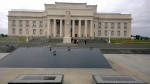
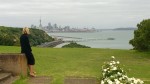
Our coach duly turned up and we set off inland for a trip around the local area. It was similar to the countryside around Tauranga growing pretty much the same stuff, though there were more vineyards. Our driver said that the wine produced in this area was some of the best in New Zealand and we passed one that belonged to a hotel chain which grew wine only for their hotels. It couldn’t be bought in any other outlet. One way to ensure your customers return, (if they like the wine that is). The vineyards were surrounded by tall hedges of either a thin wall of conifers or bamboo, up to a height of about ten metres to protect them from the wind. Not that the wind is a problem in itself, but by creating this wind break they raise the temperature inside the cordon by another two or three degrees and thus get a higher sugar content from the grapes.

We drove through one or two little hamlets and down to a little town called Kerikeri which has two of the oldest buildings in New Zealand, but the wooden one built in 1821 and the stone one built in 1835 reminds you of just how short the history of New Zealand is compared to European History. Maori’s did not have a written language until Hone Heike (a Maori chief) came to the UK and travelled to Cambridge where academics worked with him to create a written version, in order that they could write some of the history of the Maori people from the stories they told. Oh! and translate the bible into Maori. I’m not sure how easy a language Maori is to learn, but apparently an early missionary Henry Williams taught himself to speak fluent Maori in three months. Now that either makes it a heck of an easy language to learn or someone is telling porkies.

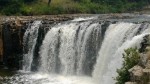
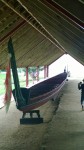
Further on we encountered the Waitangi River which has a solid rock riverbed. This is because when a nearby volcano erupted the lava flowed down the valley until it finally cooled and it was at this point that the Haruru Falls were formed. On down the valley we travelled until we arrived back at Waitangi and the start of our trip. It was here that the treaty was signed and a lot of the early shenanigans with Maori’s occurred but to this day the Maori’s remain the only indigenous race that has a written agreement with the British Government. The largest canoe in the world is also here. 36 metres long it holds 150 Maori’s and when Princes Diana was carried in it, the Royal Navy recorded it travelling at a speed of 27 knots. Some canoe!

Anyway I could go on for ever about this place but I’d better stop or I’d run into tomorrow, talking of which, clocks go back again tonight which puts us exactly 12 hours in front of you.

Beached whales and serial killers

Thursday 27th February

Back at sea again and we are heading West across the Tasman Sea for two days heading for Sydney our final destination for this leg of the voyage. So a late breakfast and a wander down to the theatre to watch another presentation by Dr Visser this time on why whales throw themselves on the beach and become stranded. The answer? No one knows. But she went through the possibilities. Whatever the reason it seems that the majority strand after following the key whale on to the shore. However she did have some good advice on what to do of you come across a stranded whale. Which basically boils down to, make sure it is upright, cover it in sheets (to keep the sun off it and help keep it wet), pour water over it to keep it wet, point it towards the sea and wait for the tide to come in. But then the chances of coming across a beached whale are few and far between (though I did think I saw one on Blackpool beach once, though on closer inspection it had a swimsuit on).

A later talk by was much more interesting. Publicity for it said ‘Adults Only’ and it was called Serial Killers. It was by a personality profiler Diane Simpson. She was an elderly lady so tiny she could hardly see over the podium with her frail old ladies voice she could have easily played Miss Marple. But her style could make your blood run cold. She had a rather slow but precise diction, at times barely a whisper (but the microphone was good). She had interviewed many serial killers including Peter Sutcliffe (who by the way is believed to have killed about 77 people). But she could be funny as well. She told us she had been in nearly all the high security hospitals and prisons (including Bellmarsh) and as she approached the front of the stage she said it’s so nice to see so many familiar faces. But some of the stories she had to tell were truly gruesome and she took us through the mental processes of some of these killers. She was up to date too, as she had the background of the girl from Peterborough who was arrested recently for killing those guys found in ditches. Coupled with the video clips, for me it was one of the best so far.

Not much else to report, we went to the gym and then had a couple of drinks in the Commodore with a couple on our table who are leaving the ship in Sydney. Dinner was the last formal night of this leg so we had lobster, getting good at predicting the menu now.

Clocks go back again tonight, putting us eleven hours ahead of you and that’s about it.