Wednesday 26th February
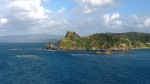
The Bay of Islands is another 150 miles north of Auckland and is a truly beautiful part of North Island with a plotted 142 islands around a coastline of bays and long silvery beaches. Captain Cook named it the Bay of Islands but New Zealand was first visited and named New Zealand after Zealand in Holland, in December 1642 by the Dutch Explorer Abel Tasman. I share this with you not as a history lesson, but for some interesting facts behind his discovery. He never set foot on land, his two ships anchored off in the Bay and the local Maori’s seeing these strange vessels arrive, sounded an alarm on an instrument that looked like a short didgeridoo and made a sound not unlike a trumpet.
It turned out that someone on one of the ships actually had a trumpet and thinking he could do better than that, let rip with a rendition of ‘Oh My Papa’ or the 1642 equivalent. Well! what the unfortunate Eddie Calvert wannabe didn’t know, was, whatever he played, was effectively a declaration of war to the Maori, a sort of musical equivalent of “Oi! come over ere if you want some!” Talk about red rag to a bull, Maori’s everywhere on hearing this immediately stopped whatever they happened to be doing, and looked at each other with that look that you know means trouble. One of those ominous silences descended over all the local bars (or the Maori equivalent) and never being ones to duck a fight they promptly put on their best fighting clobber, launched their war canoes and headed for the Dutch ships. The ship’s companies leant on the rails enjoying the spectacle thinking it was some kind of welcome. It just happened that a cutter rowing between the two ships was intercepted by these canoes and the unfortunate occupants clubbed to death. Whereupon the two ships hurriedly weighed anchor and beat a hasty retreat, whilst fighting a desperate regard action, no doubt thinking “That was a bit over the top! If that’s the way they react to poor trumpet playing goodness knows how they would react to something more serious”. Anyway the upshot was, no one went near the place for another hundred years (especially trumpet players) well would you? Until, yes you’ve guessed it, good old Captain Cook arrived like the proverbial bad penny, with a better trumpet player and the rest as they say is history.
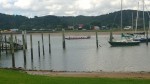
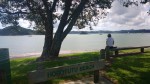
We anchored about a mile off and went ashore in a tender as the bay was too shallow for the ship to get alongside, even if there had been anything go alongside. We landed at Waitangi (famous for the Waitangi Treaty between the Crown and the Maori). The place reminded me of a cross between the Lake District without the crowds and a dales village. We caught the shuttle bus into Paihia (pronounced Pie Here) about 2 km and wandered round a sort of cross between a village fête and a handicraft market, then along the high street. Paihia is like all the other places we have seen in New Zealand spotlessly clean and really friendly. As we were due on a trip in the afternoon we decided to walk back to Waitangi along the beach of Teti bay, picking up shells as we went. This really was a place you could spend more time at.
Our coach duly turned up and we set off inland for a trip around the local area. It was similar to the countryside around Tauranga growing pretty much the same stuff, though there were more vineyards. Our driver said that the wine produced in this area was some of the best in New Zealand and we passed one that belonged to a hotel chain which grew wine only for their hotels. It couldn’t be bought in any other outlet. One way to ensure your customers return, (if they like the wine that is). The vineyards were surrounded by tall hedges of either a thin wall of conifers or bamboo, up to a height of about ten metres to protect them from the wind. Not that the wind is a problem in itself, but by creating this wind break they raise the temperature inside the cordon by another two or three degrees and thus get a higher sugar content from the grapes.
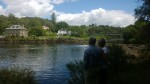
We drove through one or two little hamlets and down to a little town called Kerikeri which has two of the oldest buildings in New Zealand, but the wooden one built in 1821 and the stone one built in 1835 reminds you of just how short the history of New Zealand is compared to European History. Maori’s did not have a written language until Hone Heike (a Maori chief) came to the UK and travelled to Cambridge where academics worked with him to create a written version, in order that they could write some of the history of the Maori people from the stories they told. Oh! and translate the bible into Maori. I’m not sure how easy a language Maori is to learn, but apparently an early missionary Henry Williams taught himself to speak fluent Maori in three months. Now that either makes it a heck of an easy language to learn or someone is telling porkies.
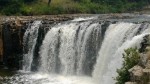
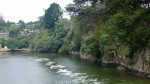
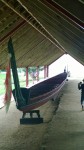
Further on we encountered the Waitangi River which has a solid rock riverbed. This is because when a nearby volcano erupted the lava flowed down the valley until it finally cooled and it was at this point that the Haruru Falls were formed. On down the valley we travelled until we arrived back at Waitangi and the start of our trip. It was here that the treaty was signed and a lot of the early shenanigans with Maori’s occurred but to this day the Maori’s remain the only indigenous race that has a written agreement with the British Government. The largest canoe in the world is also here. 36 metres long it holds 150 Maori’s and when Princes Diana was carried in it, the Royal Navy recorded it travelling at a speed of 27 knots. Some canoe!
Anyway I could go on for ever about this place but I’d better stop or I’d run into tomorrow, talking of which, clocks go back again tonight which puts us exactly 12 hours in front of you.