Friday 21st February
The approach to Nuku’alofa in the Kingdom of Tonga was different to all the other islands, in that we first saw the odd tiny rock showing above the surface of the sea, followed by what seemed to be an occasional bush growing from the surface of the sea. Very odd! Then clumps of bushes, then a few trees surrounded by bushes until everywhere we looked there were tiny tufts of bushes with the odd palm tree on. One or two islands were like the cartoons you see of a shipwrecked sailor sitting with his back to a single palm tree, only of course there was no shipwrecked sailor, or not that we could see in the early morning light, just a single lonely palm tree waiting for a sailor to sit under it. The islands got larger the closer we got to Nuku’alofa. It was quite a sight as the shallows or reefs and shoals extend about four nautical miles from the port. Approaching Nuku’alofa, we passed the Royal Palace looking for all the world like Southfork (Dallas! Remember?), except it had the Tongan flag flying from the centre tower over the front door.
We berthed at a brand new pier (paid for by the Chinese) only a third the length of the ship, in a tropical downpour and to greet us were twenty or so Tongan singers and dancers performing a welcome dance. Their drenching didn’t dent their enthusiasm one jot and in fact it made their harmonised lilting melody all the more heart-warming as it soared up to us through the sound of the torrential rain. We stood and watched the whole performance, cheering them to the rafters (well the leaden clouds) before going down to muster for our tour of the Island. As we left the ship, the rain had slowed to a light shower and the Tongan Police band had replaced the dancers, but they were playing under a gazebo.
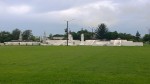
We boarded our coach which was parked in an inch of water courtesy of the deluge and our guide for the day Dianne apologised for the weather so delightfully it was if she had been personally responsible. She welcomed us to the Kingdom of Tonga and talked us through the programme. First stop the Royal Palace the one we sailed passed on our way in. The Queen Mother lives there now. Apparently the King lives in his own pad somewhere else on the Island. We stopped for a photo (just as they do at Buck House) and as we stood in the light rain we could hear the Police band across the bay doggedly playing “In the mood” which raised a few smiles. We then drove on to the royal tombs not quite Westminster Abbey but we get the drift. Lots of white and impressive statues of long departed Kings.
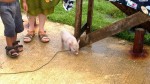
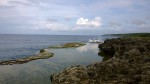
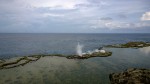
On we drive, through neat neighbourhoods with garden plants many UK gardeners would die for, but (unlike the UK), pigs seem to be the pet of choice, until we learn that they are usually kept for suckling pigs, a local delicacy we were to sample later. We arrive at the blow holes, a phenomenon that appears on many of these islands. As the sea wears away the coral shoreline below sea level small holes to the surface become exposed and each incoming wave forces either air or water through the hole at a pressure that either creates a geyser or a whistle or a mixture of both. Good fun, but in concentrating on waiting for the next wave we almost missed two pods of dolphins that had come to see what all the tourists were looking at. Whilst at the blow holes we wandered round the little stalls that seem to accumulate wherever tourists gather and one of the stallholders had a baby piglet on a lead quite cute until you remember why.
Talking of cute, the tiny children had a good little business going there. When a coach pulled up they all ran from the various stalls their parents had, not to the coach, but to a couple of benches where they sat and sang a mixture of Polynesian and western children’s songs whilst one of them strummed a tiny guitar. The little cardboard box in front of them soon filled up with dollars. I have to admit I chucked a couple in, but the old ladies chucked more, they were ooing and aahing for as long as the songs kept coming. As soon as the children showed signs of stopping more dollars flowed. Wish I’d thought of that when I was a choir boy.
Anyway onwards and upwards as someone once said and we moved on to the part of the island where the Flying Foxes were. We were told that these are not native and are only on the island because an ancient King won a canoe race and was given one as a prize. He brought it back to the island in triumph and they now have hundreds (don’t ask, the same thing ran through my mind but I didn’t want to embarrass Dianne by asking). We were informed that only Royalty were allowed to touch them and looking up at them I couldn’t help thinking they were welcome. They shoot and eat them, sounds like some other royals I know of. They taste like – yes you’ve guessed – chicken!) They are quite large about the size of a rook (apart from the wings which are larger and are bats wings) and unusually for bats they are extremely active during the day. They only eat fruits though so your blood is safe. Carol and one or two others spotted some huge spiders hanging from the telegraph wires, that had bodies the size of golf balls, Mary wouldn’t get off the bus because of them. One of the most common tree we saw turned out to be the breadfruit tree, about the size of a fully grown sycamore tree and covered in fruits the size of mangoes, we were told they fruit all the year round and are the staple diet of many families. We tasted some at the feast and whilst not at all unpleasant you wouldn’t want to eat them every day no matter how many different ways there are to prepare them. It reminds you that no matter how idyllic a place looks, to some of the people who are born and live there, it’s just the place where they struggle to survive, which makes our final destination seem all the more of a privilege.
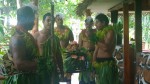
We arrived at what was referred to as the resort, which turned out to be a large Polynesian eating/drinking/dance area, tiered and open on two sides. Here we were to lunch and watch a show which depicted the Tongan traditional dances and customs. After a welcoming drink (locally brewed beer, quite good and not at all like lager) we watched as the ceremony of bringing in the suckling pig was performed. It was, I hasten to add, fully prepared and cooked by this stage even though it still looked exactly like the little piglet we had seen earlier at the blow holes. It was carried in on something like a stretcher covered in leaves and flowers, by four chanting ‘Warriors’ who halted every few steps to perform some kind of ritual. The suckling was carried through to the banquet table where it was given pride of place. Following the ceremony we all took our plates to be loaded up from the myriad of local specialities on offer, things like Taro, Sweet Potato, Bread Fruit and Clams as well as the more conventional foods like Chicken, Tuna and mixed don’t know what’s, but all cooked in a Tongan style. The final piéce de résistance to the already loaded plate was a chunk of the suckling pig. During the meal we were entertained by a group of local musicians and singers who were later to accompany the dancers. After the remnants of the meal were cleared away we watched the Polynesian dancers perform their traditional dances. The warriors with their Hakka style and the girls with their exaggerated swaying hip moves, accompanied by the close harmony South Pacific style singing, though the first dance the girls performed whilst sitting cross-legged on the floor and was similar to the hand jive but a lot more elegant. I’m not surprised that Captain Cook’s men were so captivated they didn’t want to leave the Island and it was in this area the famous mutiny on the Bounty took place. By the way the name Nuku’alofa translates as nuku meaning abode and alofa meaning love. Nothing more to be said there then.
When we arrived back at the ship the police band were back to play us away, manfully working their way through their entire play list. The jetty became one large party area and when lady in red was played, one of the Aussies grabbed a local girl in the traditional red kimono style dress and danced with her, to huge applause and her huge embarrassment. After a lot of effort by ships security to get everyone on board, encouraged by some prolonged blasts on the ships sirens, the gangway was finally hauled up and we began to slowly inch ourselves away from the quay. Crowds lined the shore and the jetty waving, sirens blasted out farewells, and the police band struck up with the song I think from South Pacific, but the chorus the crowd were singing had the line ‘While you are sailing far across the sea. Please remember me’
Those Tongans know how to make you feel welcome.