Monthly Archives: January 2014
New York – Photos
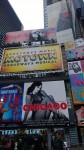
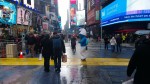
Welcome to the kiddies’ table
Wednesday 22nd January
Back at sea again we headed south through the Bahama Channel, North of Cuba, skirted round the island and headed South East following the coastline of Cuba at a distance of about three miles, so we were able to see a lot of the geographical skyline of the island. By midnight we had closed on the eastern tip of the island whereupon we proceeded through the Windward Passage and then set a south easterly course to Haiti. We are currently in the Caribbean Sea with Cuba to the North of us, Haiti to the East and the Island of Jamaica to the South West of us. As we are now heading East again the clocks go forward one hour at 02:00 tonight, that’s going to come hard.
I went to a lecture on the restoration of the Wilts & Berks Canal and the Kennet & Avon which was quite interesting but Carol swerved it for some reason, can’t think why, but she did come to the following talk ‘Conquest of the Atlantic’ a 175 year history of the greatest and grandest trans-Atlantic liners.
Dinner was a formal night and surprise surprise, we have a new couple to replace Roger and Barbara, but we have not been in port, how come? The new couple, another Michael and Carol, were seated with a table that spoke only French and the only couple that could speak English got off in Fort Lauderdale. Faced with another two weeks of struggling with the little French they spoke, they requested a move and ended up with us. The phrase frying pan to the fire springs to mind.
Weather is continuing to warm up with temps around 24°C and lots of sun. No good will come of it, you mark my words.
Oh and one final thing today, a big welcome to Suzanne who has just registered on the blog. Suzanne your dad has forbidden me to report anything without his approval :-).
He didn’t pay up
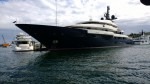
All at sea again
Thursday 23rd January
We are now in the Caribbean Sea ‘proper’ and setting a south easterly course for the Island of Aruba by midnight we shall be more than halfway across the Caribbean Sea with about 350 nautical miles left to run to the port of Oranjestad in Aruba. We are experiencing the effect of the Trades Wind belt which takes the heat out of the sun, very dangerous if you are sitting in it. Bill Bryson is Cunard’s celebrity speaker on this leg of the cruise so we went along to listen even though we had not heard of him before. He is, we understand, a bestselling author. Well it was OK, he read some amusing bits from his books, but he admitted his publishers said that he had to push his new book and if his books are not your bag then as I said he was OK, but he did have a lot of fans there. We then watched a presentation on the Panama Canal, its history, construction, and operation, which I thought was much more interesting.
Dinner was formal night again, but before dinner we had another Captains Welcome Reception for the new arrivals, cocktails in the Queens Room. I guess we will have had quite a few of these come the end of the cruise. After dinner we had a bit of a mooch round before going up as we have a 6:30 rise in the morning.
Oh and welcome to the blog Georgina the same goes for you as goes for Suzanne 🙂 (see yesterday’s post).
Alice Through the Looking Glass Island
Friday 24th January
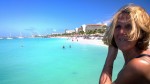
Early start today, the alarm went off at 6:30am and by the time we were showered and up for breakfast we were approaching Aruba. By 09:30 we were ashore to a steel band welcome and the sight of all the officials enthusiastically dancing along to the music.
Our guide for the day, Gwen was a stickler for protocol, we were told to remember our seat numbers as sitting in someone else’s seat often resulted in a black eye. To leave the coach, the right side would disembark first, followed by the left. At the next stop this would be reversed and woe betide anyone who talked when she was.
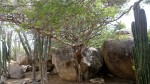
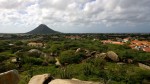
Aruba is an island of the Lesser Antilles, 16 miles from the coast of Venezuela and measuring a mere 19 miles long by 6 miles wide, a strange amalgam of beautiful pure white beaches azure blue seas and a barren arid desert interior. The reason for this is because the island is solid rock of various types, but much of it old coral as the island was born from the sea thousands of years ago. There are no rivers, rainfall is limited and as a result very little grows here, plant life is restricted to Coconut and other palms, Aloe Vera, cactuses, and Divi-Divi trees. Pronounced the same way as beaver-beaver but with a d.
Ah! I hear you all exclaim, Divi-Divi trees? Yes, a Divi-Divi tree grows straight up until it reaches the branches, all of which point South West at a sharp right angle (useful if you get lost on an island measuring 19×6 miles) but such is the case with the Divi-Divi tree. Also a Divi-Divi tree’s seeds are extremely valuable in the tanning process of leather. However the island has only two cows, both of which are kept in a zoo, which means that many of these seeds go to waste.
If you don’t believe that then read no further, because the cactus that grows on Aruba is even stranger. The tall cowboy cactus produces jam!….. They do! The plant produces little pots of red jam. They grow on the outside of the plant a sort of brownish reddish colour, but they’re a bit hazardous to pick and you have to race the ants, the lizards and the birds for it, because it is so delicious that you ain’t got no chance if you is slow! (in the words of our guide). However if “you is slow” all is not lost because inside the long tall arms there is wood. Which you can use to build things, if others have eaten the jam.
Now you may think that with only Coconuts, Aloe Vera, Cactus Jam and Divi-Divi seeds to live on, one can be excused for thinking that the life span of a resident of Aruba is not long. Well you would be wrong, for some bizarre reason the life span of an Island resident used to be over a hundred years, but is now nearer eighty. This is due to the westernised diet that has become the islander’s fare. However we were told when you do eventually die they don’t put you six feet under, they put you six feet up, because they can’t bury you. The ground is too hard to dig a traditional six foot grave, so they put you in a little coffin shaped box and pile you one on top of each other, a bit like stacking shipping containers. Each container is decorated in the same style as the deceased house was, to make them feel at home so to speak and to verify the story we diverted via a local graveyard where the coffins were particularly tastefully decorated.
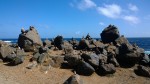
Gwen later pointed out that we may have noticed a number of little piles of stones atop of every available rock. She said the significance of these to the islanders meant (pause for dramatic effect) absolutely nothing. She was as bemused as everyone else who lived on the island, by these little piles of stones. It turns out that tourist are responsible. For some reason, known only to themselves tourist are driven to making little piles of stones atop any available fixed piece of rock and as other tourists see these little piles of rocks they assume that it’s an island custom and so do likewise.
And talking about rocks, the abundance of coral means that the dry stone walls (a subject close to my heart as some of you will know) have some interesting stones set in them. One particular wall had a piece of Brain Coral set into it, unfortunately when I got back to the ship I realised that photograph I took, was not of the section of the wall that had the brain coral in. You can imagine my disappointment.
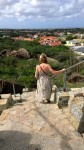
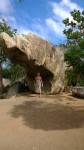
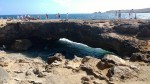
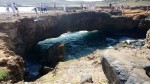
We were then taken to such a large piece of coral that the islanders had carved steps into it. So we all climbed the steps to the top of the coral took some pictures of the island and climbed back down again. And the trip went on in much the same vein, a Bustop made of coral (I took a photo of Carol waiting for a bus under it) a restaurant made of coral, a lighthouse made of, yes, coral. They even took us to see two bridges made of coral but unfortunately the big one had fallen down, (eroded away by the action of the sea) so a disconsolate Gwen told us that it was now one small bridge and a fallen down big bridge, but if we looked at the small bridge we could imagine what the big bridge did look like before it fell down. So we all dutifully looked at the small bridge and imagined the once proud big bridge as it used to be. Sad really! As a whole collection of souvenir shops and ice cream vendors had relied on the two bridges and somehow a little one and a fallen down big one didn’t quite have the same ring to it.
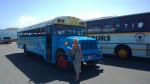
Anyway we all made our way back to our coach, which was Air conditioned, I mention this fact because whilst we were away mourning the demise of the big bridge, an island tourist couch had arrived and parked next to ours and Gwen pointed out it’s energy efficient air conditioning – a complete absence of windows. I took a photo of Carol next to it and made a mental note to advise Shaun of the concept the next time the Jolly Brewers bar gets overheated.
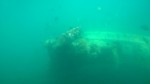
Anyway on to the highlight of the tour, a trip in a semi sub. A semi sub is not really a semi sub it is a boat with windows under the water line, but semi sub sounds more exiting and it would have been churlish to argue what in fact was a moot point. This trip was to look at fish and a sunken ship. I couldn’t help musing on the fact that it was a bit insensitive to show a whole load of passengers from a cruise ship, fish swimming around a sunken ship. But they did and it was very interesting.
It seems that at the outbreak of war this German freighter found itself on the wrong side of the Atlantic so whilst anchored off this (then) neutral island they cogitated on their predicament. Should they attempt to run the blockage of Royal Navy ships, submarines and aircraft or spend the war in this paradise of a neutral tropical Island with its pure white beaches and azure skies. Then just as they were mulling over their options, fate, as fate tends to do, took a hand in things. Mr Hitler made a move that was to seriously inconvenience the crew of this particular freighter, he invaded Holland. Oops! Suddenly this Dutch Antilles tranquil paradise had become a whole lot more menacing, and sure enough they were soon to observe a boatload of Dutch marines heading their way. They were informed quite politely that they had twenty-four hours to depart or face the consequences. Rock and a hard place must have sprung to mind. But the captain was a resourceful man and he ordered the boilers to be lit and that steam be got up. The island observed the smoke from the stack and smiled in grim satisfaction, having advised the allies of the presence of this particular vessel. The chief engineer reported to the captain that steam was up and if he did not leave soon would be up to dangerous levels. The captain ordered the ship’s crew to board the boats and leave the ship. He then made his way below, put the blowers on the boilers up to full, opened the sea cocks and made his way back on deck and clambered down to the last remaining boat. As they made their way to the shore there was a humongous explosion and down she slowly went. The crew spent the war on their tropical island as POW guests of the Dutch Marines. And we ended up peering down at what remains of their ship.
By this time our heads were reeling with all the strange stories we had been told and returned to the ship, wondering if we had been the victims of some complicated practical joke. But I think not, but this really is an island that makes Alice Through the Looking Glass appear sensible.
Another Day at Sea
Saturday 25th January
Day at sea again en route to Limon Costa Rica and back to catch up time. Weather is now in the hot to very hot category with the added danger of a brisk cooling wind, too dangerous for me. I leave that sort of stuff to Carol, who is slowly turning a mahogany brown. I went to the final talk on the Panama Canal which was about the recent and nearly completed modifications that will more than double capacity using 7% less water. These modifications mean the canal will be able to take much larger ships (the Queen Mary will be able to transit once the new bit is open). Up to now ships have either had to be built to a size that will fit the existing locks (the so called Panama ships) or built much bigger and use alternate routes like the Suez. Later Carol wanted to go and watch the ships chefs put on a cooking demonstration, proper curries and posh easy puddings etc. I went along just in case there was some tasting to do. There wasn’t!
Dinner was formal again and being Burns night we had haggis, I say we, what I should have said was, we all had haggis except for Carol who being a Scot and knowing exactly what is involved in the making of the beast, steered well clear. Well that’s my theory, Carol of course denies it, which she would I guess, having been sworn to secrecy as a bairn. Anyway we then went to watch the aforementioned haggis be addressed (puzzled me a bit as I thought this was meant to happen before we ate it) which it duly was and then we watched an attractive young lady in a miniskirt dance the sword dance. Well I say the sword dance, the swords were actually two pieces of hardboard wrapped in tinfoil, but that’s being a bit picky in these days of health and safety and anyway I wasn’t paying much attention to the swords if the truth were told. When the fun was over we went up to bed as tomorrow is another early start 5:45am even though the clocks go back an hour again tonight.
Jungle Expedition
Sunday 26th January
Up at 5:50am Limon still a distant dot on the horizon showered, shaved and up for breakfast in record breaking time. Whilst enjoying a full English we watched as the officer of the watch turned the ship round performing a perfect 180 degree pirouette in the centre of the tiny Limon harbour with Celebrity Equinox impatiently waiting to follow us in. Both ships will discharge a total of over 4,000 passengers onto the small town. We make our way down to the theatre for the start of our tour, arriving ten minutes late 7:10 and having been given our little sticky badges (no. 4) we sat and waited a further 20 minutes whilst gangway are put in place and other procedures are gone through etc. etc. By 7:45 we were all packed into our coach and on our way. The temperature is already 23°c and humidity close to 100% Our guide Leonardo tells us that there are ten different habitats in Costa Rica, but we won’t be seeing all of them. We are heading for the tropical rain forests, mangroves and lagoons. As we travel along the shore road we see black rocks on the surf which we are informed is coral that previously was under water. It is now nine inches out of the water following an earthquake in 1990/91. We are then told that Costa Rica has about a hundred tremors a day most of which you can’t feel, but with all this geothermal activity going on underground there are 112 volcanoes 80 of which are still active. Not to worry we are going to see birds and butterflies 900 species of the former and 15,000 species of the latter, though we won’t see them all. Thank goodness for that we’d be here all year. Leonardo is none stop in his delivery of facts about Costa Rica, suffice to say that banana crop is the main export followed by pineapple, coffee, sugar and palm oil. But he assures us that the banana is not the real thing, it is a hybrid bred for the demands of the western supermarket and he then produces a carrier bag from which he pulls ‘real bananas’ all of two inches long and tasting delicious. We all had some and they really were nice a sort of delicate banana flavour and sweeter than the supermarket model and less floury.
After a short drive we pull up alongside a train with steps up to an open ended carriage like in the old fashioned cowboy films. Air conditioning was the same as the energy efficient air conditioning on that bus in Aruba – a complete absence of windows. We were warned not to put our heads or hands out of the window as they could be sliced off by the undergrowth and he wasn’t joking. There was to be no commentary whilst the train was moving, because he could not make himself heard over the noise. Rickety was an understatement. As we lurched and trundled along with branches attempting to snatch us out of the carriage, we noticed we could see the track between the floorboards.
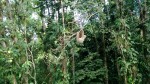
The forest was dense and even if you had wanted to get out and walk there was no space between the trees. When we looked down onto the forest we could see black, brackish water glinting in what little sunlight that penetrated. Goodness knows what horrors lurked there. We were beginning to enjoy our trip when we suddenly ground to halt with lots of excite shouting in Spanish from our guides. They had spotted a three toed Sloth. The train reversed up a little and there it was, just hanging around, as three toed Sloths do. It doesn’t look a comfortable existence at all but he seemed happy enough from what we could see, he didn’t do much, but then Sloths don’t do they. Further up the track we screeched to a halt again accompanied by more excited chatter. The guides had spotted some spider monkeys, the train positioned itself so that we could see them all and then the guides started calling in monkey language to encourage them down, but they were having none of it and just stared down at us with that bored monkey expression and scratched their… well they scratched. We had to get moving and off we went again staring at the butterflies and brightly coloured birds. One that shot by us was jet black with the brightest red breast I have ever seen.
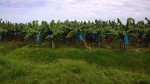
Soon we were seeing the waves crashing on the beach through the trees on the right and we travelled along for a few miles with forest to the left and the ocean to the right, before coming to the region where banana plantations began to appear on both sides of the train. Banana trees grow to maturity in six months, produce a full stem of bananas three months later and then die. Each bunch of bananas is covered by a plus plastic bag and Leonardo asked for suggestions as to why this may be. There were several, I ventured that it meant they were pre-packed by the time they were ready for picking. Leonardo’s look was all that was required to indicate the absurdity of that remark. It turns out that there are several reasons, they create an even micro climate, the bag protects against the sun and so ensures an even ripening of all the fruit at the same time. Without the bag the top bananas would ripen first in the sun and by the time the bottom bananas had ripened the top ones would have withered and they protect against insects & spraying. And why blue, because black would mean that the temperature would be too high inside the bag and red is nature’s warning signal that would deter beneficial insects. I forgot the reason against yellow, it was a long day. It’s a great climate for bananas apparently, because Limon is in the tropical rain belt and in close proximity to the equator the temperate is even all the year round (28°/32° degrees). Perfect for banana growing, I now know why they don’t grow bananas in Accrington.
Anyway by now we were nearing the mangrove that we were to tour by boat but before that we stopped for a selection of fresh fruits and a bottle or two of local Costa Rican beer. The fruit was great, trays and trays of it freshly cut into bite size pieces. The beer (lager) was, well lager. Those of you who know me will be aware of the speed at which I can down an IPA. I had barely drunk an inch of my beer (lager) when we were told the boat was ready. So I snuck my glass on the boat (even if it is lager, I wasn’t going to leave it and it lasted the whole two hours).
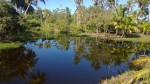
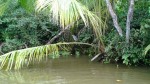
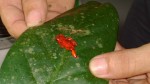
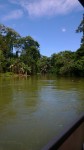
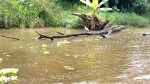
Before we cast off we were told that the crocodiles were a cosmopolitan bunch and they loved the variety foreign tourists bought them, so to keep our hands out of the water. I had no intention of putting anything of mine in the water before the warning and certainly not now, anyway I was holding my beer (lager) with one hand and my camera with the other. We castoff and had hardly gone a hundred yards before we screeched (as best a boat can screech) to a halt. Leonardo had spotted a Little Blue Heron, a beautifully formed miniature Heron with a body about the size of a starling but the colour Wedgwood blue, with feathers so fine it didn’t seem to have them. Further down the same manoeuvre was performed and we looked up to where Leonardo was pointing excitedly and saw nothing. “There! There! there!” he shouted, where? where? where? we all thought as we stared up into the canopy, all l could see was tree branches. Then like one of those weird pictures that if you stare at long enough suddenly transforms to a landscape, we saw it only twenty or so feet away, a massive Green Iguana. We only spotted it because it moved to eat a leaf. It looked big enough to bite your head off, I instinctively drew back, as I was aware that in my eagerness to spot it I had stretched my neck out somewhat and did not want to look like a tasty morsel. After a lot of camera clicks and ooh’s and aah’s we continued on our way through the dangling creepers, stopping every few yards it seemed, each time Leonardo had spotted something new and most of the times we had to look hard to see whatever it was until we saw it and then we couldn’t believe we had missed it. Something’s like the little birds that constantly buzzed the boat were easy to see, but when we asked what they were, Leonardo dismissed them with a wave of his hand, just mangrove swallows he sniffed. Typical the one thing we could see and they were barely worth a mention. Another excited halt and we could see, just hanging around, a Sloth. Oh! another Sloth we said (feeling quite the experts) we were soon put right. This is a one toed Sloth, Leonardo informed us. The other one was a three toed Sloth, suitably chastened we all pretended we knew that and it was the others who didn’t. I toyed with the idea of asking him if there was a two, four and five toed Sloth but after the episode with the blue plastic bag, I didn’t. And so it went on the Yellow Crowned Red Eyed Heron, the Brazilian Long Nosed Bat (no! I’m not making these up), the Snowy Egret with yellow toes that it wiggles in the water so that fish think it’s a worm, when the fish swim up to grab them, they get grabbed. Bit risky I thought after what they had told us about the crocodiles, perhaps crocodiles only eat tourists and wildebeest (or am I getting my continents mixed up). It didn’t seem long at all before we were on our way back, but not before our boat driver had rammed the bank tied up and shot into the jungle. We thought he’d gone for a Jimmy, but it turned out he’d heard the call of the Blue Jeaned Frog, I thought this was a stylish Frenchman, or a euphemism girls used for drunken sailors who try to pick them up, but it turns out that the Blue Jeaned Frog is a deadly frog that can kill a man just by looking at them (my mother-in-law can do that). It is bright red with blue legs, and our intrepid coxswain comes out of the jungle proudly carrying one on a leaf. Phew! we all took pictures, I took one over Carol’s shoulder, reasoning that it was men that these frogs kill not women. Apparently they get their poison by eating poisonous ants, digesting the ant and storing the ant’s venom. Nice, some of these creatures. After we had all taken a picture the coxswain passed the frog to another boat that had pulled up to see what all the excitement was about. Their guide was passing a picture of the frog round her passengers and was a bit squeamish about taking the real thing. Don’t worry luv I thought it’s a man killer, you’ll be OK.
So with that excitement over with, we hurtled back to our jetty at an exhilarating speed, as whilst the Blue Jeaned Frog had not killed anyone, it had delayed us.
Leonardo told us on the coach back to the ship that we had only seen a fraction of what Costa Rica had to offer and that if we spent a fortnight there we would see as many different species each day. It was a good pitch and we are going to see some more in a couple of days or so. I will let you know if what he said is true. But it was a great day out.
Download Video
Entering the Panama Canal – Webcam time-lapse
Unfortunately it seems that ships are asked to turn off any webcams while transiting the canal, but here is a time-lapse up until the point the camera cuts out.
Through the Panama Canal
Monday 27th January
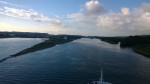
05:45 Pre-dawn, woke to the sight of ships lights as far as the eye could see and that was from our cabin, I stopped counting at 40. The ship was creeping along, picking its way carefully through the ships jostling for position to transit the Panama Canal. We pick the pilot up at 07:30 whilst we are having breakfast. Dawn is beginning to assert its grip on the day as the tropical rain clouds turn from black through thunder grey, then light grey. We are being fussed over by three canal authority launches carrying out various formalities required before we can commence our transit. Finally we are allowed into the canal zone under pilots control, past the breakwater. Panama is the only place in the world where the pilot takes full control of the navigation of the ship. Everywhere else the captain stays in control and the pilot advises.
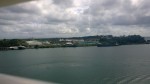
While we are still creeping forward at a snail’s pace, the sun finally breaches the horizon and the effect under the leaden sky is dramatic. All the waiting ships light up as if under a giant searchlight outlined against a dark grey background. There is a stunned silence as the full effect is taken in, all those ships lit up in a golden glow. Then just as quickly it was gone as the sun rose above the cloud base and out of sight until later in the day. That sight alone was worth getting up early for. As we approach the shoreline we can see that it is covered in lush green tropical rain forest, a reminder along with dense cloud that we are in the tropical rain belt. While we are still six miles from the first set of locks, we pass a huge container terminal, puzzling at first, but this is where ships that are too big to transit the Panama discharge their containers, which are then taken the 50 miles or so from the Atlantic to the Pacific by train, double decked. Quite a sight.
We continue to creep at little more than walking pace towards the first set of locks, passing the entrance to the new canal being built to double the capacity of the canal on our left and almost exactly opposite, poignantly, the abandoned French canal. Even from this view we can see why the Panama Canal has been described as the largest and most difficult engineering projects ever undertaken. As we approach the first lock we watch the ship ahead exit and enter the second chamber. The gates close behind her and turbulence outside the gates we are approaching, indicate that our lock is emptying in readiness to accept us. Right in front of the dock gates we can see traffic flowing, there is a single track swing bridge that allows traffic to cross the canal whilst the lock gates are closed, however traffic has to wait up to 45 minutes if the gates are in use. Must remember this when next waiting at the Waterbeach crossing.
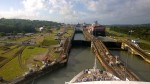
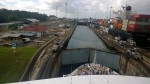
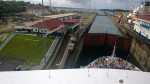
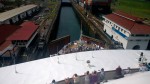
Now the fun starts. On both sides of the lock, little train tugs called Mules are getting into position to drop their cables to us. They have a very deep intermittent warning buzz. They won’t pull us through the lock, (our engines drive us forward), as we will only have two feet between us and the lock wall on either side, their cables are only used to keep us central in the lock. A little rowing boat departs from the lock side with the cables from one of the mules and then does the same for the other mule. Bells ring, lights flash and the road bridge swings back into little housings in each side of the lock wall. The main lock gates begin to swing back to admit us into the first lock and with the mules taking up the slack on the cables and croaking like oversexed bull frogs we start to inch forward into the first chamber. At the same time the ship ahead of us is exiting the second lock into the third. We slip effortlessly into the first lock with three mules on each side of us keeping us central and the gates behind us close. The ship ahead of us is now in the third lock and we are in the first. Water from the second lock starts to empty into ours at the rate of 3 million gallons per minute and the ship starts to rise at a remarkable rate, due to the fact that most of the lock is occupied by ship and there is very little room for water. We are soon 28ft higher and ready to move into the second lock, while the ship ahead is ready to move out of the third lock onto the Gatun Lake. The process is then repeated in the second lock and we rise another 28ft and then finally the third lock. When we exit that lock we are 85ft above sea level and sailing in fresh water which affects our buoyancy, though not enough for us to notice, this mainly affects bulk carriers. Looking back we can see on the left the Gatun dam, which was used to create the largest man-made lake in the world at the time it was built and on the right we can see where the new canal will exit onto the lake. From entering the first lock at 08:10 to exiting the third lock at 10:20 the whole process has taken two hours ten minutes.
Clustered around the locks on the Gatun Lake are more ships waiting to descend the locks to the Atlantic.
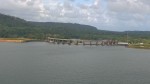
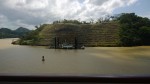
We start to cross the Gatun Lake following the course of the original Gatun river bed which is the deepest part of the lake. And as we wind our way between islands that were once hilltops there is evidence everywhere of major work, dredging, widening and landscaping. They had hoped that the new canal would open on the one hundredth anniversary of the opening of the first canal in 1914. But they are not sure when this will now happen but they look like they are going flat out to get it finished. The course across the lake is approximately 22 miles and just prior to arriving at the locks that will take is down to the Pacific we have to pass through the Culebra Cut which is the narrowest part of the canal. The cut was excavated through solid rock and traverses the continental divide. This was the most difficult and dangerous part of the original construction and for the expansion they had to widen it using explosives whilst still handling traffic. There is still only space for traffic in one direction in this part of the canal.
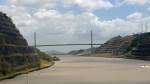
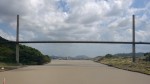
We finally arrive at the Miraflores Locks which will allow is to descend to the Pacific I won’t go through the procedure again as it is the same going down as it was going up, (but in reverse). After passing through the locks we travel under the Bridge of America and out into the Pacific Ocean a journey of 51 miles that took us about eleven hours, at 85 feet above sea level, not bad when you consider how far it is and how long it would take to sail round Cape Horn.
A sea day tomorrow, we can catch up on some sleep.