Monday 27th January
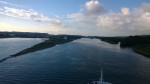
05:45 Pre-dawn, woke to the sight of ships lights as far as the eye could see and that was from our cabin, I stopped counting at 40. The ship was creeping along, picking its way carefully through the ships jostling for position to transit the Panama Canal. We pick the pilot up at 07:30 whilst we are having breakfast. Dawn is beginning to assert its grip on the day as the tropical rain clouds turn from black through thunder grey, then light grey. We are being fussed over by three canal authority launches carrying out various formalities required before we can commence our transit. Finally we are allowed into the canal zone under pilots control, past the breakwater. Panama is the only place in the world where the pilot takes full control of the navigation of the ship. Everywhere else the captain stays in control and the pilot advises.
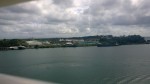
While we are still creeping forward at a snail’s pace, the sun finally breaches the horizon and the effect under the leaden sky is dramatic. All the waiting ships light up as if under a giant searchlight outlined against a dark grey background. There is a stunned silence as the full effect is taken in, all those ships lit up in a golden glow. Then just as quickly it was gone as the sun rose above the cloud base and out of sight until later in the day. That sight alone was worth getting up early for. As we approach the shoreline we can see that it is covered in lush green tropical rain forest, a reminder along with dense cloud that we are in the tropical rain belt. While we are still six miles from the first set of locks, we pass a huge container terminal, puzzling at first, but this is where ships that are too big to transit the Panama discharge their containers, which are then taken the 50 miles or so from the Atlantic to the Pacific by train, double decked. Quite a sight.
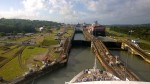
We continue to creep at little more than walking pace towards the first set of locks, passing the entrance to the new canal being built to double the capacity of the canal on our left and almost exactly opposite, poignantly, the abandoned French canal. Even from this view we can see why the Panama Canal has been described as the largest and most difficult engineering projects ever undertaken. As we approach the first lock we watch the ship ahead exit and enter the second chamber. The gates close behind her and turbulence outside the gates we are approaching, indicate that our lock is emptying in readiness to accept us. Right in front of the dock gates we can see traffic flowing, there is a single track swing bridge that allows traffic to cross the canal whilst the lock gates are closed, however traffic has to wait up to 45 minutes if the gates are in use. Must remember this when next waiting at the Waterbeach crossing.
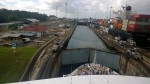
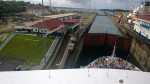
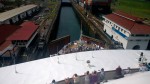
Now the fun starts. On both sides of the lock, little train tugs called Mules are getting into position to drop their cables to us. They have a very deep intermittent warning buzz. They won’t pull us through the lock, (our engines drive us forward), as we will only have two feet between us and the lock wall on either side, their cables are only used to keep us central in the lock. A little rowing boat departs from the lock side with the cables from one of the mules and then does the same for the other mule. Bells ring, lights flash and the road bridge swings back into little housings in each side of the lock wall. The main lock gates begin to swing back to admit us into the first lock and with the mules taking up the slack on the cables and croaking like oversexed bull frogs we start to inch forward into the first chamber. At the same time the ship ahead of us is exiting the second lock into the third. We slip effortlessly into the first lock with three mules on each side of us keeping us central and the gates behind us close. The ship ahead of us is now in the third lock and we are in the first. Water from the second lock starts to empty into ours at the rate of 3 million gallons per minute and the ship starts to rise at a remarkable rate, due to the fact that most of the lock is occupied by ship and there is very little room for water. We are soon 28ft higher and ready to move into the second lock, while the ship ahead is ready to move out of the third lock onto the Gatun Lake. The process is then repeated in the second lock and we rise another 28ft and then finally the third lock. When we exit that lock we are 85ft above sea level and sailing in fresh water which affects our buoyancy, though not enough for us to notice, this mainly affects bulk carriers. Looking back we can see on the left the Gatun dam, which was used to create the largest man-made lake in the world at the time it was built and on the right we can see where the new canal will exit onto the lake. From entering the first lock at 08:10 to exiting the third lock at 10:20 the whole process has taken two hours ten minutes.
Clustered around the locks on the Gatun Lake are more ships waiting to descend the locks to the Atlantic.
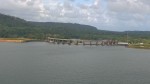
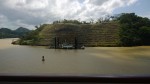
We start to cross the Gatun Lake following the course of the original Gatun river bed which is the deepest part of the lake. And as we wind our way between islands that were once hilltops there is evidence everywhere of major work, dredging, widening and landscaping. They had hoped that the new canal would open on the one hundredth anniversary of the opening of the first canal in 1914. But they are not sure when this will now happen but they look like they are going flat out to get it finished. The course across the lake is approximately 22 miles and just prior to arriving at the locks that will take is down to the Pacific we have to pass through the Culebra Cut which is the narrowest part of the canal. The cut was excavated through solid rock and traverses the continental divide. This was the most difficult and dangerous part of the original construction and for the expansion they had to widen it using explosives whilst still handling traffic. There is still only space for traffic in one direction in this part of the canal.
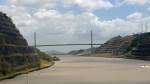
We finally arrive at the Miraflores Locks which will allow is to descend to the Pacific I won’t go through the procedure again as it is the same going down as it was going up, (but in reverse). After passing through the locks we travel under the Bridge of America and out into the Pacific Ocean a journey of 51 miles that took us about eleven hours, at 85 feet above sea level, not bad when you consider how far it is and how long it would take to sail round Cape Horn.
A sea day tomorrow, we can catch up on some sleep.